TRUS Biopsy Report Workflows: AI Letters for Irish Urologists
Streamline your TRUS biopsy report workflows. Discover how Irish private urologists use AI to draft complex histology letters, saving hours of weekly admin.

Built in Dublin · GDPR · 7-day trial
MedPro saves Irish clinicians 9–18 hrs every week.
The Administrative Burden of the TRUS Biopsy Report in Private Practice
The administrative overhead of a transrectal ultrasound (TRUS) guided prostate biopsy does not end when the procedure is complete. For a private urologist in Ireland, the arrival of a histology report triggers a cascade of time-consuming tasks: drafting distinct letters for the patient and their GP, ensuring accurate transcription of complex data, and initiating the correct follow-up pathway. This manual process is a significant drain on both consultant and secretarial time.
A stack of pathology reports from the lab at the Mater Private or Bons Secours arriving late on a Thursday afternoon is a familiar sight. Each PDF contains critical, structured data: Gleason score, ISUP Grade Group, number of positive cores, percentage of tumour involvement, and the presence or absence of perineural invasion (PNI). The challenge is not interpreting this data, but communicating it accurately and efficiently to multiple parties while simultaneously managing the clinical next steps.
The traditional workflow involves dictating a summary. This single dictation must then be transcribed by a secretary, who manually types out the complex terminology. One letter is adapted for the GP, containing the full clinical picture and management plan. A second, carefully worded letter must be created for the patient, explaining the results in understandable terms without causing undue alarm. Each step introduces the potential for delay and human error. A simple transcription mistake in a Gleason score (e.g., 3+4 vs 4+3) can have significant clinical implications. This entire sequence can take days, leaving the patient in a state of considerable anxiety.
 ▶ Watch on YouTube
Why Traditional Dictation Fails the Complex Histology Follow-Up
Traditional dictation is an inefficient, linear tool for a non-linear, data-driven task like histology follow-up. It creates a transcription bottleneck, delaying vital communication to patients and GPs. This method fails to automatically trigger the necessary subsequent actions, such as booking an MDT slot or scheduling a follow-up PSMA PET scan, relying instead on manual secretarial intervention for every step.
The core failure of the dictaphone in this context is its inability to interact with structured data. A urology consultant reading a histology report is not just narrating; they are processing specific data points that dictate a clear clinical pathway. According to the National Cancer Control Programme (NCCP) guidelines on prostate cancer, the management strategy is directly influenced by risk stratification based on PSA, clinical stage, and Gleason Grade Group. A diagnosis of Gleason 3+4=7 (Grade Group 2) intermediate-risk disease requires a different set of communications and actions than Gleason 4+5=9 (Grade Group 5) high-risk disease.
Dictation conflates data extraction, interpretation, and communication into a single, slow-moving audio file. The process looks like this:
- Interpretation: The consultant reads the PDF and decides on the management plan.
- Dictation: The consultant verbalises the findings, the plan, and instructions for two separate letters.
- Transcription: A medical secretary listens to the audio and manually types the information, often having to pause and look up complex terms to ensure accuracy.
- Review: The draft letters return to the consultant for review and signature, potentially hours or days later.
- Action: The secretary then manually acts on the plan—phoning the patient, booking an MRI, or adding the patient to an MDT list.
This multi-day cycle is fraught with inefficiency. It keeps the consultant and secretary tethered to low-value administrative work, delaying the delivery of crucial results and slowing down the entire prostate cancer pathway. The process is simply not fit for the demands of a modern, multi-site urology practice operating across hospitals like the Blackrock Clinic and the Hermitage.
How Urology Reporting AI Transforms Pathology Data into Draft Letters
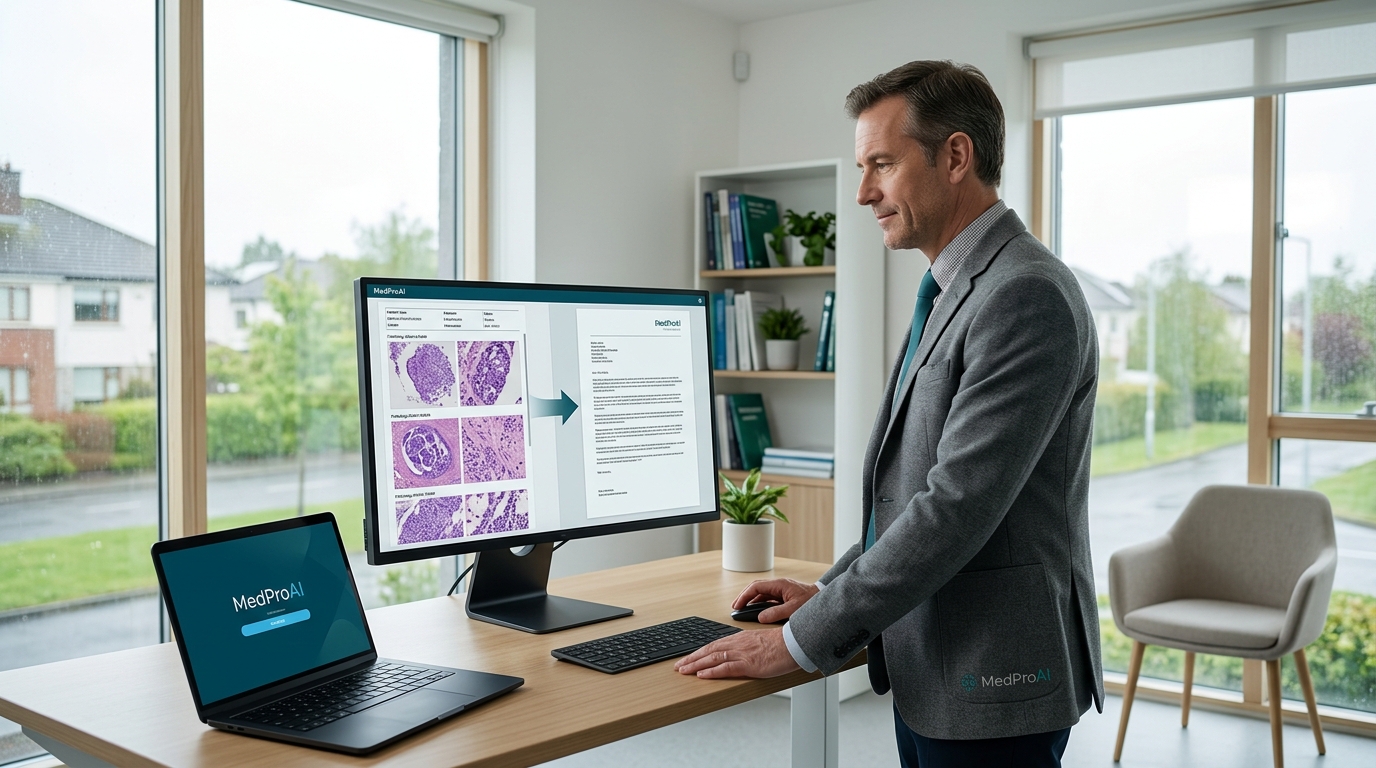
Urology reporting AI automates the initial, most time-consuming step of the reporting process. It uses natural language processing to read and extract structured data directly from the digital pathology report—such as Gleason score and core details—and uses this information to populate pre-approved letter templates. This generates accurate, context-specific drafts for both the GP and patient in seconds, ready for consultant review.
Instead of a consultant dictating and a secretary typing, the workflow becomes one of clinical oversight. The AI acts as a hyper-efficient assistant, handling the rote task of data transfer and initial drafting. Platforms incorporating an AI agent, like MedProAI's Brigid, can parse a PDF report from any Irish pathology lab once a secure digital connection is established. The core value is converting unstructured or semi-structured information into actionable, pre-formatted communications.
The process transforms the workflow from manual transcription to automated drafting:
- Secure Ingestion: The PDF histology report is received directly into the practice management system from the hospital lab (e.g., St. Vincent's Private, UPMC Whitfield) via a secure digital channel.
- AI Data Extraction: The AI scans the document, identifying and extracting key data points: patient identifiers, PSA at time of biopsy, Gleason score, ISUP Grade Group, number of cores taken, number of positive cores, percentage involvement, and comments on PNI or intraductal carcinoma.
- Template Application: Based on the extracted data (e.g., 'Gleason 3+3' vs 'Gleason 4+5'), the system selects the appropriate, pre-written and consultant-approved template. Different templates exist for benign results, low-risk cancer, high-risk cancer, and atypical findings.
- Draft Generation: The AI populates the chosen template with the patient's specific data, instantly generating a draft letter to the referring GP and a separate draft letter for the patient. It can simultaneously create a task for the secretary to book an MDT discussion for high-risk cases.
- Consultant Review & Sign-Off: The consultant receives a notification that drafts are ready for review. They can read, edit, and approve the letters with a single click. The consultant remains in complete control, but their time is spent on high-value clinical validation, not dictation or proofreading for typos.
This AI-driven approach significantly shortens the time between receiving a result and communicating it, directly addressing a major source of patient anxiety and administrative delay. It also systematises the process, ensuring that every prostate biopsy letter follows a consistent, best-practice format.
Navigating Risk: Clinical Safety Safeguards in AI Letter Generation
The primary clinical safety safeguard in AI-driven letter generation is the non-negotiable ‘human-in-the-loop’ model. The AI’s role is strictly limited to drafting documents based on provided data and approved templates. It never makes a clinical decision, interprets ambiguity, or sends any communication without explicit review and sign-off from the consultant urologist. This ensures final clinical authority always rests with the clinician.
Introducing automation into clinical workflows rightly raises questions about risk and accountability. The architecture of a safe system is built on the principle that AI is a tool to augment, not replace, clinical judgement. A 2022 study in the Journal of Medical Internet Research evaluating AI in clinical documentation emphasised that physician oversight is essential for ensuring accuracy and mitigating risk. In the context of a TRUS biopsy report, this means the system is designed to handle the 90% of predictable, data-driven drafting, while flagging any ambiguities for human intervention.
Key safety features include:
- Mandatory Clinician Approval: No letter or patient communication can be sent without the consultant electronically signing off on the final version. The system’s default state is 'draft', requiring active confirmation.
- Confidence Scoring: When the AI extracts data, it can assign a confidence score. If it encounters an unusual format or ambiguous phrase in the pathology report, it can flag the specific field for mandatory manual review, preventing errors from propagating.
- Immutable Audit Trails: Every action is logged. The system records who reviewed the document, what edits were made (if any), and when it was sent. This creates a complete, auditable history for every patient communication, which is a key principle outlined in HIQA's guidance on information management.
- Template Control: The letter templates themselves are locked and can only be created or modified by authorised users, typically the consultant. This ensures the core clinical language and advice remain standardised and pre-approved.
The goal is not to create an autonomous system but to eliminate the most error-prone and time-consuming part of the existing workflow: manual transcription. By automating the draft, the consultant’s focus is elevated from basic dictation to pure clinical validation—a more effective and safer use of their expertise.
Integrating AI Workflows with Irish Private Hospital Pathology Labs
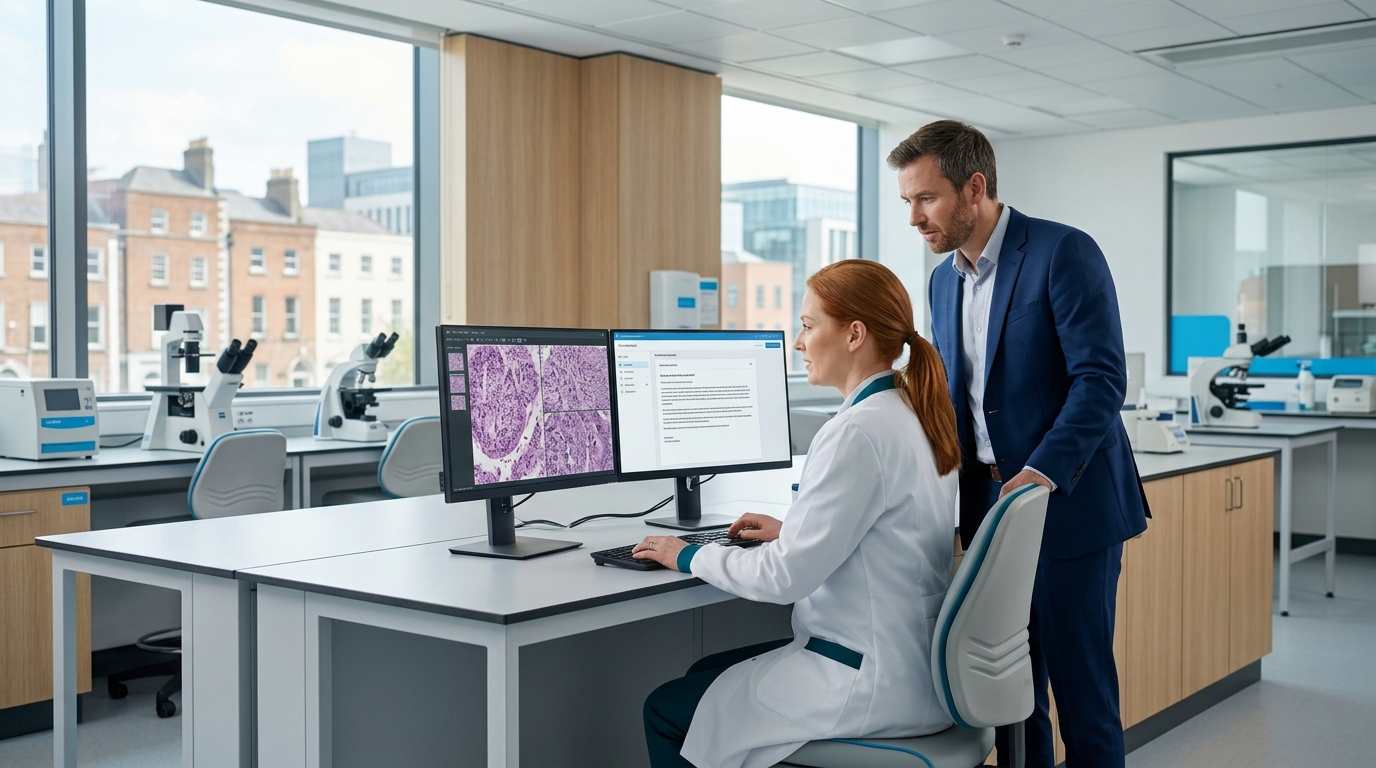
Effective integration with Irish private hospital labs requires establishing secure, GDPR-compliant digital channels to replace legacy methods like fax, post, or unencrypted email. The workflow hinges on pathology departments sending reports as structured data or standardised PDFs directly into a practice's secure digital inbox. This enables the AI to ingest and process the information automatically, eliminating manual data entry and scanning.
The challenge for a urologist practising across multiple sites—a common scenario for those with rooms in Dublin and clinics at the Beacon Hospital and in a regional centre—is the lack of a unified system. Pathology results may arrive in different formats from different labs. A reliable practice management system must be able to handle this variance. The integration is less about deep, real-time API connections (which are rare in the current Irish private hospital landscape) and more about optimising the flow of information.
A comparison of the traditional versus the integrated workflow highlights the difference:
Achieving this requires collaboration with the administrative departments of the pathology labs. The initial setup involves designating a secure email address or HealthLink endpoint as the destination for all reports for that specific consultant. This simple change in process on the lab’s side can unlock massive efficiency gains within the urology practice, creating a more streamlined experience for consultants working across multiple Dublin private hospitals and beyond.
Empowering Patients: Sharing Histology Outcomes Securely via MedYou
A secure patient app allows the finalised, consultant-approved histology letter and management plan to be shared directly and instantaneously with the patient. This empowers them with immediate access to their results in a clear format, reducing the profound anxiety of waiting for a letter in the post. It provides a single, secure place for them to review their clinical information at any time.
The period after a prostate biopsy is one of heightened stress. Delays in communication are a major contributor to this anxiety. By integrating patient-facing technology, the communication loop can be closed almost instantly once the consultant signs off on the result. A dedicated patient app like MedYou provides a secure, GDPR-compliant portal where patients can receive sensitive documents. This is fundamentally different from sending an email, which is often not secure enough for this level of personal health information.
The patient-centric benefits are clear:
- Immediacy: The patient receives a notification the moment the consultant releases the document. They can read their results on their own phone, in their own time, without waiting days for the postal service.
- Clarity and Accessibility: The information is presented clearly and is permanently available within their app. They can refer back to the consultant's letter when discussing the outcome with family or preparing for their follow-up appointment.
- Enhanced Control: The patient holds their own results. This aligns with the principles of patient-centred care advocated by bodies like the Royal College of Surgeons in Ireland (RCSI), giving patients more agency in their healthcare journey.
- Reduced Inbound Calls: For the practice, this dramatically cuts down on the number of phone calls from anxious patients chasing their results. This frees up secretarial time to focus on other tasks, such as coordinating theatre lists or managing insurer pre-authorisation.
This model puts the patient in control of their information. When the consultant finalises the review of the AI-drafted histology letter, they have an option to 'Release to Patient App'. This single click makes the definitive document securely available to the patient, closing the loop with efficiency and empathy.
Future-Proofing Your Irish Private Urology Practice for 2026
Future-proofing a private urology practice involves adopting integrated digital systems that can manage increasing clinical complexity and rising patient expectations for communication. It means shifting from fragmented, manual administrative processes to a unified platform that automates repetitive tasks, ensures data integrity, and provides a frictionless experience for both clinicians and patients. This is not about radical change, but about strategic adoption of proven technology.
The landscape of urology is evolving. Diagnostic tools are becoming more precise, treatment pathways more personalised, and patient engagement more critical. A practice built on paper files, dictaphones, and disparate software for billing and scheduling will struggle to keep pace. The administrative burden will continue to grow, consuming valuable clinical time and increasing overheads. The future belongs to practices that structure their operations around a central, intelligent system.
Key pillars for a future-proofed practice include:
- A Single Source of Truth: Consolidating patient records, communications, billing, and scheduling into one system. This eliminates data silos and provides a comprehensive view of the patient journey, from initial referral to post-operative follow-up.
- Workflow Automation: Identifying and automating repetitive administrative tasks. This starts with AI-driven letter generation for PSA results and biopsy reports but extends to automated recall campaigns, insurer billing, and digital consent forms.
- Patient-Centric Technology: Implementing tools that give patients control over their administrative interactions with the practice, such as online booking, digital payments, and secure access to their own results and letters.
- Data Security and Compliance: Ensuring the entire technology stack is built on a foundation of secure infrastructure, hosted within the EU, and fully compliant with GDPR and HIQA standards.
Investing in this kind of modern practice management infrastructure is no longer a luxury; it is a strategic necessity for maintaining efficiency, profitability, and high-quality patient care in the competitive Irish private healthcare market.
A practical first step is to audit your current workflow for a single, high-volume task like processing histology results. Map out every manual step, from the moment the report arrives to the point the patient and GP are informed. This exercise will immediately highlight the bottlenecks and reveal the clear opportunities for automation.
MedProAI offers a 7-day free trial for Irish practices, providing a hands-on way to see how these workflows function in a real-world setting. Visit auth.medproai.com to try it.
Frequently asked questions about TRUS biopsy report
How does AI assist with a TRUS biopsy report in private urology?
AI tools analyse structured pathology data from a TRUS biopsy report and automatically draft comprehensive clinical letters for GPs and patients, reducing manual dictation time.
Can patients access their prostate biopsy letters directly?
Yes, using patient-first platforms like MedYou, patients can securely log in to view, download, and share their finalised clinical letters and results once the consultant approves them.
Is AI-generated clinical correspondence GDPR-compliant for Irish consultants?
Yes, provided the AI tool is built on secure, EU-hosted infrastructure that complies with GDPR and does not use patient data to train public models.
Does the AI make clinical decisions regarding the histology follow-up?
No, the AI only assists in drafting the correspondence based on the consultant's input. The private consultant retains full clinical oversight and must review and sign off on every letter.
How do patients manage their records across multiple private clinics?
Through the MedYou app, patients maintain control of their own profile and can choose to share specific categories of information with different clinics, with the ability to revoke access at any time.
Frequently Asked Questions
Ready to give Brigid the admin?
Start your 7-day free trial — no charge until day 7, full access. Or book a 20-min walkthrough with our team to see Brigid run a workflow with your own data.
EU-hosted · GDPR · No charge until day 7 · Cancel any time