Multi-Site Urology: Coordinating Dublin's Private Hospitals
Managing a urology practice across the Beacon, Mater Private, and Blackrock Clinic requires unified patient intake and secure, patient-led document sharing.

Built in Dublin · GDPR · 7-day trial
MedPro saves Irish clinicians 9–18 hrs every week.
The Multi-Site Urology Challenge: Beacon, Mater Private, and Blackrock
The core challenge for a urologist practicing across Dublin’s private hospitals is logistical fragmentation. Operating between the Beacon, Mater Private, Blackrock Clinic, and others creates duplicated administrative work, siloed patient data, and significant non-clinical overhead. This structure forces the consultant’s private rooms to act as the sole, manually-operated hub for coordinating a patient's entire care journey.
For a consultant urologist in Dublin, a typical week is a study in managed fragmentation. Monday might be a clinic list at the Beacon Hospital, Tuesday could be a theatre list at the Mater Private, and Wednesday might involve ward rounds at the Blackrock Clinic or Hermitage. While this model offers flexibility and access to diverse patient cohorts and facilities, it imposes a substantial and often underestimated administrative burden not on the hospitals, but directly on the consultant's own practice.
Each hospital operates as an independent entity. This means separate patient administration systems (PAS), distinct booking procedures, and individual electronic health record (EHR) or imaging (PACS) systems. The practical implications are immediate and costly:
- Appointment Coordination: Your medical secretary may need to call the bookings department at one hospital to schedule a flexible cystoscopy, then liaise with a different department at another hospital to arrange a follow-up consultation, all while cross-referencing your own calendar to avoid clashes.
- Data Inconsistency: A patient seen at your rooms in the Beacon consultants clinic is, from the Mater Private's perspective, a new patient. Their demographic data, insurance details, and even clinical history must be recaptured, re-entered, and re-verified, introducing opportunities for error with every transcription.
- Insurer Friction: Pre-authorisation for a prostate biopsy (TRUS) for a VHI patient at one hospital involves a different process and contact point than authorising the same procedure for a Laya Healthcare patient at another. This complexity multiplies the administrative time required for managing urology billing and pre-authorisation.
The cumulative effect is that the consultant’s practice—often just the consultant and a medical secretary—becomes the de facto integration engine. It is the only entity that holds a complete view of the patient's pathway, from initial referral to post-operative follow-up. This manual stitching-together of information is time-consuming, expensive, and a significant source of clinical risk and professional burnout.
 ▶ Watch on YouTube
Why Hospital IT Silos Drive Up Administrative Overhead for Dublin Consultants
Hospital IT systems are built for internal governance and billing, not for direct, frictionless data exchange with external practices or other hospitals. This intentional lack of interoperability forces consultants' teams to manually bridge the information gap through phone calls, emails, and re-keying data. This inflates administrative costs and introduces significant risk of error into patient care coordination.
The fundamental issue is that a hospital's IT infrastructure is procured to serve the hospital's operational and financial needs. A system like the Mater Private's or Blackrock Clinic's is designed to manage bed occupancy, internal billing, and staff rostering efficiently. It is not designed, nor is it incentivised, to easily share information with a visiting consultant's separate practice management software, let alone with the systems of a competing private hospital down the road.
This reality is compounded by the absence of a unified health identifier in the Irish private sector. As noted in strategies aiming for better data integration, such as the HSE's 'Digital Health and Social Care Strategy', a cohesive digital identity is foundational for interoperability. Without it, each encounter at a new location requires the creation of a new, separate record. According to HIQA's guidance on information governance, while data security is paramount, the structures must also support continuity of care. The current siloed approach often hinders this continuity.
For a urology practice, this manifests in several costly ways:
- Fragmented Results Management: A PSA test is performed at a laboratory contracted by the Beacon. The result returns to the hospital system. To ensure it is actioned correctly within your practice's own recall protocol, your secretary must often manually retrieve this result and re-enter it into your system. This is a critical failure point for dependable PSA recall campaigns.
- Duplicated Dictation Effort: You dictate a letter following a consultation in one clinic. If that patient is later admitted for a procedure at another hospital, that letter needs to be found, printed, scanned, and sent across—a process reliant on manual effort and prone to delays.
- Billing Discrepancies: A single episode of care, such as managing a kidney stone, might involve a consultation at your rooms, imaging at Hospital A, and a ureteroscopy at Hospital B. Your practice is left with the task of collating these separate events, each with its own procedure and insurance codes, into a coherent set of invoices.
The overhead is not just financial. The time spent by highly skilled medical secretaries on low-value administrative tasks is a significant drain on practice resources. It's time that could be spent on patient communication, managing complex cases, or improving practice efficiency.
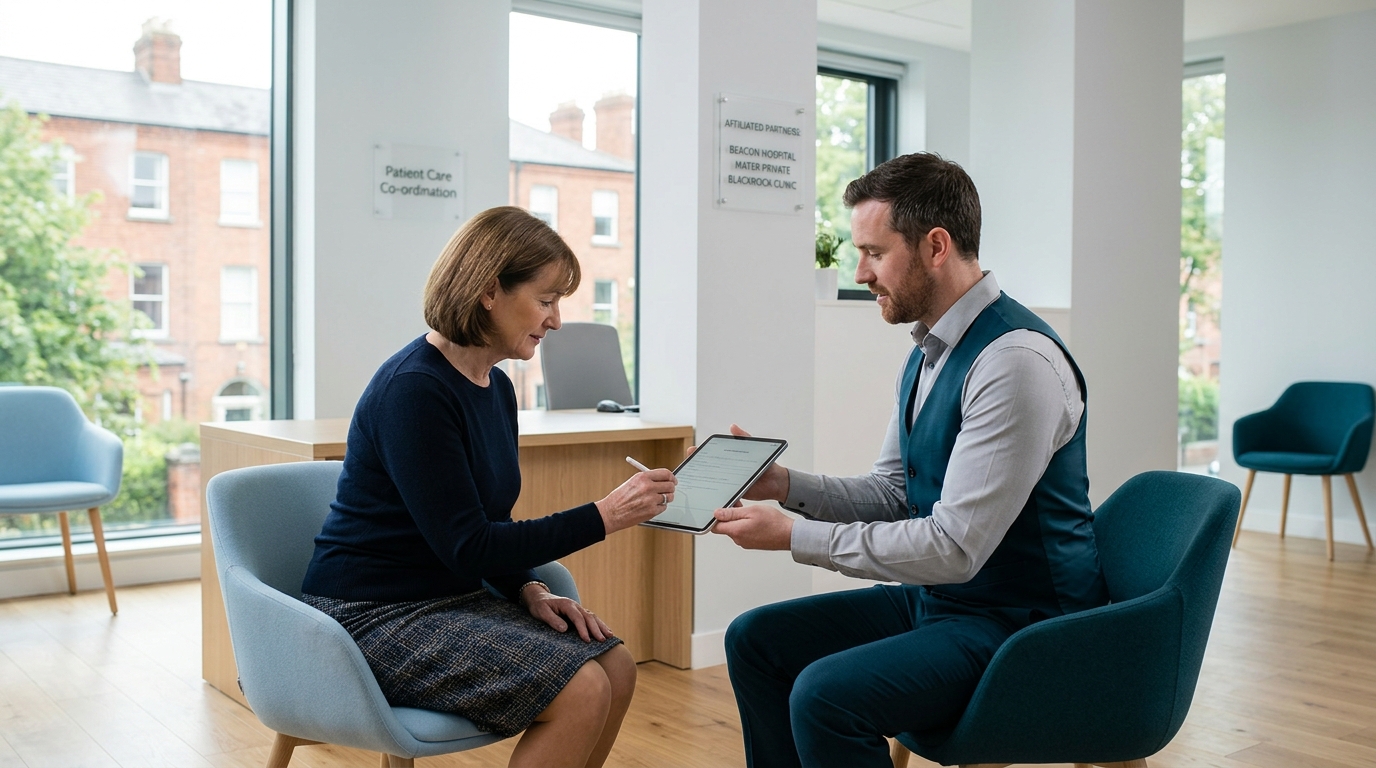
Streamlining Patient Intake and Consent Across Multiple Private Venues
Standardising patient intake and consent across different hospitals requires a single, consultant-controlled platform that operates independently of any single hospital's IT system. This enables a consistent digital workflow where patients provide their information once, with that data then being securely used and distributed for each specific episode of care, regardless of location.
The traditional patient onboarding process for a multi-site urology practice is inefficient by design. A new patient being scheduled for a consultation at your rooms in one hospital and a procedure in another will likely be asked to fill out two separate sets of paperwork, providing the same name, address, date of birth, and VHI policy number each time. Consent for a procedure, like a flexible cystoscopy or vasectomy, is often handled via a paper form signed just moments before the procedure, a practice that the Royal College of Surgeons in Ireland (RCSI) and medical indemnity bodies are increasingly scrutinising.
A more efficient and compliant approach decouples the intake and consent process from the hospital itself, placing it under the control of the consultant's practice. This involves using a central platform to manage the patient journey from the point of referral.
Comparison: Intake & Consent Models
| Feature | Traditional Multi-Site Process | Centralised Platform Approach |
|---|---|---|
| Patient Intake | Separate paper or PDF forms for each hospital. Patient repeatedly enters the same information. | One secure digital form completed once. Data is reused for subsequent appointments at any location. |
| Procedure Consent | Paper-based consent signed on the day, often under time pressure with limited opportunity for questions. | Digital consent forms sent to the patient days or weeks in advance for review and e-signature at their leisure. |
| Insurance Details | Secretary manually collects and verifies VHI/Laya/Irish Life details by phone for each appointment. | Patient enters and confirms their own insurance details digitally, reducing transcription errors. |
| Data Accuracy | High risk of transcription errors (e.g., misspelt names, incorrect policy numbers) from manual data entry. | Reduced error rate as the patient is the source of their own data. |
| Admin Time | Significant secretarial time spent printing, scanning, phoning, and manually keying in data. | Administrative workload shifts from data entry to verification and exception handling. |
By implementing a centralised system, the urology practice creates a single source of truth for patient administrative data. When a patient needs a procedure at the Hermitage, the necessary demographic sheet or pre-authorisation form can be generated from the central system, populated with data the patient has already provided and verified. This not only saves secretarial time but also presents a more professional and coherent experience for the patient.
Empowering Patients to Bridge the Information Gap Between Sites
Patients can become active agents in their care coordination when equipped with the right tools. A secure patient application allows them to hold their own key documents—such as referral letters, investigation results, and clinic summaries—and share them on-demand with the relevant clinical team at each hospital, effectively bridging the data silos that hospital systems create.
The conventional model of information transfer between hospitals is practice-centric and fraught with friction. A medical secretary faxes a referral letter, emails a PSA result, or posts a copy of a clinic note, hoping it reaches the correct recipient in a timely manner. This process is not only inefficient but also raises information governance questions, particularly when using non-secure channels like standard email. An alternative model flips this dynamic, placing the patient in control of their own data.
This is the principle behind patient-facing applications like MedYou, where the patient's own smartphone becomes the secure, portable repository for their care documents. The workflow is transformed:
- Initial Consultation: A patient sees you at your rooms in the Blackrock Clinic. After the consultation, the letter summarising the findings and recommending a prostate biopsy is securely published to the patient's app.
- Procedure Scheduling: The patient is scheduled for their TRUS biopsy at the Beacon Hospital a few weeks later.
- Patient-Mediated Information Sharing: The pre-assessment nursing team at the Beacon needs the initial consultation letter. Instead of your secretary finding and faxing it, the patient can grant access to the document directly from their app. They control who sees their information and for how long.
This approach directly aligns with the spirit of GDPR, particularly the right to data portability. As outlined by Ireland's Data Protection Commission (DPC), individuals have a right to receive their personal data in a structured, commonly used, and machine-readable format and have the right to transmit that data to another controller. While the hospital systems remain siloed, the patient themselves becomes the 'API', carrying the necessary data between sites in a secure and compliant manner.
The benefit for the consultant is a significant reduction in administrative chasing. The need for follow-up phone calls to confirm receipt of a fax or to resend a lost email diminishes. The responsibility for bridging the information gap shifts from the practice's administrative staff to a secure, patient-controlled digital process.

The Future of Multi-Hospital Practice: Patient-First Data Portability
The future of an efficient consultant practice across multiple hospitals does not depend on waiting for those hospitals to integrate their IT systems. Instead, it lies in adopting consultant-centric platforms that prioritise patient data portability. This model establishes the consultant's practice, not any single hospital, as the central hub for information, ensuring continuity of care regardless of location.
For years, the implicit assumption has been that interoperability is a top-down problem to be solved by hospital groups or national eHealth initiatives. For the private consultant, this has meant waiting for a solution that has not materialised and is unlikely to in the near future. The strategic shift is to stop waiting and adopt a bottom-up approach, utilizing modern software to create a virtual, unified practice that floats above the disparate hospital infrastructures.
This consultant-centric model provides the single source of truth for the patient's entire journey with your practice. A BPH pathway, from initial IPSS scoring through to urodynamics and a potential TURP, can be managed consistently within your own system. It doesn't matter if the urodynamics were done at the Bons Secours and the TURP at UPMC Whitfield; the complete clinical narrative resides with you.
AI-powered practice management systems are built on this principle. Platforms like MedProAI use AI agents, such as Brigid, to automate the administrative tasks that arise from hospital fragmentation. Brigid can draft referral letters, manage complex recall lists for PSA monitoring, and handle the repetitive elements of insurer pre-authorisation, freeing up the consultant and their secretary to focus on higher-value clinical and patient-facing work.
The advantages of this approach are strategic:
- Practice Resilience: Your patient database, your clinical workflows, and your administrative history are your own assets. If you decide to shift your sessional commitments from one hospital to another, your practice operations are not disrupted.
- Operational Efficiency: You gain a single dashboard to manage your entire urology practice—PSA recalls, stone disease follow-ups, haematuria triage—across all locations. This unified view is impossible when relying on siloed hospital systems.
- Enhanced Patient Safety: By centralising data, you reduce the risk of information being lost between sites. A critical allergy noted in a clinic letter from one site is guaranteed to be present in the record when booking a procedure at another.
Ultimately, this model re-asserts the consultant's role as the central coordinator of care. It uses technology to build a cohesive, efficient, and scalable practice around the consultant, providing a consistent experience for patients no matter where in Dublin they are seen.
Before considering any new software, spend one week tracking the time your practice loses to inter-hospital coordination. Tally the minutes your secretary spends on the phone clarifying appointments, chasing results from another site, or re-keying patient details for a different hospital's pre-authorisation process. The total figure will provide a clear business case for change.
MedProAI offers a 7-day free trial for Irish practices—visit auth.medproai.com to try it.
Frequently asked questions about multi-site urology
How do Dublin urologists manage patient data across the Beacon, Mater Private, and Blackrock Clinic?
Most consultants rely on manual administrative duplication or separate instances of practice software, as these major private hospitals operate on independent, non-communicating IT networks.
Can a patient share their clinical letters and results across multiple clinics?
Yes. By using patient-first applications like MedYou, patients can securely hold their own clinical documents and choose to share specific categories of information with different clinics, revoking access at any time.
How does MedYou assist a multi-site private consultant in Ireland?
MedYou is a patient-first application that puts patients in control of their bookings, billing, and results. Any practice-side convenience is a secondary effect of the patient managing their own administrative tasks.
Is patient data shared via MedYou compliant with Irish healthcare regulations?
Yes, patient data managed through the app is GDPR-compliant and hosted entirely within secure EU-based servers, ensuring strict adherence to Irish privacy standards.
Does MedYou automatically sync with internal hospital practice management systems?
No. MedYou is not a practice-management tool; it allows patients to independently share their records and intake forms directly with the clinics they choose to link with.
Frequently Asked Questions
Ready to give Brigid the admin?
Start your 7-day free trial — no charge until day 7, full access. Or book a 20-min walkthrough with our team to see Brigid run a workflow with your own data.
EU-hosted · GDPR · No charge until day 7 · Cancel any time