AI Clinical Notes: Orthopaedic Surgeon Ireland Guide to Automation
Private orthopaedic surgeons in Ireland are using AI clinical notes to automate complex SOAP documentation, saving hours of dictation time every week.
Researched and written by MedPro's AI pipeline and published automatically — not individually reviewed by a person. Useful as a starting point; check clinical, legal and regulatory details against a primary source before relying on them.

Built in Dublin · GDPR · Early access
MedPro saves Irish clinicians 9–18 hrs every week.
The Documentation Burden in Private Irish Orthopaedics
The documentation burden in private Irish orthopaedics stems from managing high-volume outpatient clinics, complex multi-site surgical lists, and demanding post-operative reporting requirements. Consultants often spend hours dictating clinical letters, operation notes, and medico-legal reports, significantly reducing available clinical time and increasing administrative overhead.
For an orthopaedic consultant operating across the Irish private sector, clinical administration is rarely confined to a single location. A typical week might involve a full-day outpatient clinic at the Beacon Hospital, a surgical list at the Mater Private, and an additional trauma or elective list in a public hospital. This multi-site reality creates a fragmented administrative trail. After seeing thirty patients in a busy joint-replacement or sports-injury clinic, the consultant is left with a stack of files requiring dictated letters back to referring GPs, detailed clinical notes for the patient's record, and complex pre-authorisation requests for radiological investigations or surgical interventions.
The traditional workflow relies heavily on digital dictaphones and medical secretaries. A consultant dictates a letter, the audio file is uploaded to a shared drive or sent via a secure portal, and a secretary types it out. The consultant must then review, amend, and sign the document before it is dispatched. This asynchronous process introduces latency into patient care. A referral for an urgent MRI to investigate a suspected meniscal tear or a complex spinal pathology can be delayed by days simply because the dictation is sitting in a transcription queue. Furthermore, managing multi-insurer pre-authorisations—navigating the distinct portals and forms required by VHI, Laya Healthcare, Irish Life, and Aviva—adds layers of friction that consume both the consultant's and the secretary's time.
According to the Faculty of Sports and Exercise Medicine (RCPI & RCSI), accurate and timely communication between secondary and primary care is a cornerstone of effective patient management. Yet, the sheer volume of typing required undermines this objective. Every total hip arthroplasty (THA) or anterior cruciate ligament (ACL) reconstruction generates a predictable cascade of paperwork: the initial consultation letter, the consent form documentation, the operation note, the discharge summary, and multiple post-operative review letters. When this administrative load is multiplied across a private practice seeing hundreds of patients a month, the cost—both in secretarial wages and the consultant's personal time—becomes substantial.
This environment is prompting a shift in how clinical data is captured. Consultants are increasingly looking for methods to bypass the dictation-transcription bottleneck. The goal is to generate accurate, formatted clinical documentation at the point of care, allowing the medical secretary to transition from audio-typing to higher-value tasks, such as theatre list coordination and managing insurer interactions. For a deeper look at how specific practices are managing this transition, see our analysis on how a private orthopaedic surgeon in Limerick is reducing administrative overhead.
 ▶ Watch on YouTube
How AI Clinical Notes Transcribe Complex Orthopaedic Consultations
AI clinical notes transcribe complex orthopaedic consultations by capturing the natural dialogue between consultant and patient, filtering out conversational filler, and structuring the relevant medical data. This technology accurately identifies specific anatomical terminology, range-of-motion metrics, and surgical grading scales to generate precise draft documentation.
The transition from traditional dictation to ambient artificial intelligence represents a fundamental change in clinical data capture. Unlike older voice-recognition software that required the consultant to dictate punctuation and explicit formatting commands ("new paragraph," "heading examination"), modern ambient systems listen to the consultation as it happens. The demand for AI clinical notes orthopaedic surgeon Ireland solutions has grown precisely because these systems understand the context of the conversation. They can distinguish between a patient describing their pain and the consultant explaining the mechanical failure of a joint.
Orthopaedics is a highly visual and mechanical specialty, and its documentation reflects this. A standard examination involves precise measurements and specific provocative tests. When a consultant performs a knee examination and verbally notes "flexion to 110 degrees, extension lags by 5 degrees, positive Lachman test, negative McMurray's," an ambient AI system does not merely transcribe these words as a block of text. It categorises them under the 'Objective Examination' section of a clinical note. It understands that a 'Kellgren-Lawrence grade 3' refers to radiological findings of osteoarthritis and places it accordingly. This ability to parse complex, specialty-specific terminology—from 'varus deformity' and 'spondylolisthesis' to specific implant manufacturers like Stryker or DePuy—is what makes the technology viable for surgical consultants.
It is critical to understand the compliance boundary of these tools. The AI acts strictly as an advanced scribe; it drafts the documentation based solely on the audio captured during the encounter. It does not make clinical decisions, it does not autonomously order X-rays, and it does not formulate diagnoses. The human-in-the-loop principle is absolute. The system generates a draft, and the consultant must review, edit if necessary, and sign off on the final document. This ensures adherence to the professional standards expected by the Irish Medical Council regarding the accuracy and integrity of patient records.
The immediate benefit of this workflow is the elimination of the transcription delay. As soon as the patient leaves the consulting room, the draft letter is ready for review. The consultant can sign it electronically, and it can be dispatched to the referring GP via HealthLink the same day. This concurrent documentation model removes the need for consultants to spend their evenings or weekends catching up on a backlog of dictation tapes, returning hours of time to their schedule.

Tailoring Voice SOAP Notes to Joint Replacements and Sports Medicine
Tailoring voice SOAP notes to joint replacements and sports medicine involves configuring AI systems to recognise sub-specialty specific clinical pathways. For arthroplasty, this means structuring pre-operative templating and post-operative recovery milestones, while sports medicine requires detailed mechanism-of-injury documentation and targeted physiotherapy referral parameters.
Orthopaedic practice is not monolithic. The documentation required for an elderly patient undergoing a routine total knee replacement differs vastly from that of a young athlete presenting with a complex multi-ligament knee injury. Effective voice SOAP notes orthopaedics software must accommodate these distinct clinical pathways. An inflexible, generic medical template will only create more editing work for the consultant.
In an arthroplasty clinic, the focus is heavily on radiological findings, conservative management history (such as prior corticosteroid injections), and surgical planning. The documentation must clearly outline the patient's functional limitation—often quantified by scores such as the Oxford Hip or Knee Score—to justify surgical intervention to private health insurers. Post-operatively, the notes shift to wound healing, implant stability, and the prevention of complications like deep vein thrombosis (DVT).
Conversely, a sports medicine or soft tissue clinic requires a granular history of the injury mechanism. Did the knee give way during a pivoting movement? Was there an audible pop? The physical examination is detailed, testing specific ligaments and menisci. The plan often involves a phased return to play, detailed physiotherapy protocols, and perhaps a referral for an MRI. The AI system must be capable of structuring these very different narrative arcs into coherent, professional medical letters.
Below is a comparison of how ambient AI structures documentation across these two distinct orthopaedic sub-specialties:
| Documentation Element | Arthroplasty Clinic (e.g., THA/TKA) | Sports Medicine Clinic (e.g., ACL/Meniscus) |
|---|---|---|
| Subjective History | Chronic pain progression, night pain, walking distance limitations, failure of conservative management (NSAIDs, injections). | Acute mechanism of injury, immediate swelling vs delayed effusion, weight-bearing status post-injury, mechanical symptoms (locking/catching). |
| Objective Examination | Gait analysis, fixed flexion deformities, leg length discrepancy, specific joint range of motion (ROM) in degrees. | Provocative testing (Lachman, Pivot Shift, McMurray, Anterior Drawer), joint effusion grading, focal joint line tenderness. |
| Radiological Review | Weight-bearing X-rays, joint space narrowing, osteophyte formation, subchondral sclerosis/cysts, templating metrics. | MRI review, specific ligamentous disruption, meniscal tear patterns (bucket-handle, radial), bone bruising patterns. |
| Plan & Output | Surgical consent discussion, pre-assessment clinic booking, VHI/Laya procedure code justification, VTE prophylaxis plan. | Physiotherapy referral with specific restrictions, bracing requirements, surgical vs conservative management discussion. |
By capturing the specific nuances of these encounters, the technology ensures that the resulting clinical letters are not only accurate but also formatted to the consultant's specific preferences, ready for immediate dispatch to the referring practitioner.
Key GDPR and EU Data Security Standards for Irish Consultants
Key GDPR and EU data security standards for Irish consultants require that clinical data processing occurs within EU-hosted servers and adheres to strict patient confidentiality protocols. Compliance necessitates explicit data processing agreements, encrypted storage, and ensuring no patient-identifiable information is used to train public AI models.
For private consultants in Ireland, data security is not merely an IT concern; it is a fundamental professional obligation. The Data Protection Commission (DPC) enforces strict penalties for the mishandling of special category health data. When introducing any form of artificial intelligence or ambient listening technology into a clinical setting, the burden of proof rests on the data controller—the consultant or their incorporated practice—to ensure that the tool is fully compliant with European law.
The most critical failure point for many consumer-grade or US-centric AI transcription tools is data residency. If an application records a consultation in a Dublin clinic and transmits that audio to a server in California for processing, it immediately creates a complex cross-border data transfer scenario that often violates GDPR principles. To mitigate this risk, Irish private practices must select software vendors that guarantee data processing and storage exclusively within the European Economic Area (EEA). Infrastructure such as Amazon Web Services (AWS) hosted in Dublin provides the necessary geographic ring-fencing to satisfy these legal requirements.
Furthermore, the mechanics of how the AI model handles the data post-consultation must be transparent. A compliant system will process the audio, generate the text, and then permanently delete the audio file. It is entirely unacceptable for a vendor to retain patient-identifiable audio or transcripts to train their future algorithms. The Data Processing Agreement (DPA) between the consultant and the software provider must explicitly prohibit the use of clinical data for machine learning training purposes. The data belongs to the practice and the patient, not the software vendor.
Security extends beyond the servers; it encompasses access controls within the practice. Medical secretaries, clinical nurse specialists, and the consultant must have distinct, role-based access permissions. A secretary may need access to the generated text to format a letter, but they should not have the ability to alter the core clinical findings recorded by the physician. Adhering to these strict protocols ensures that the practice remains aligned with the health information standards set out by HIQA, protecting both the patient's privacy and the consultant's professional standing.
How to Integrate AI Scribe Software into Your Private Practice
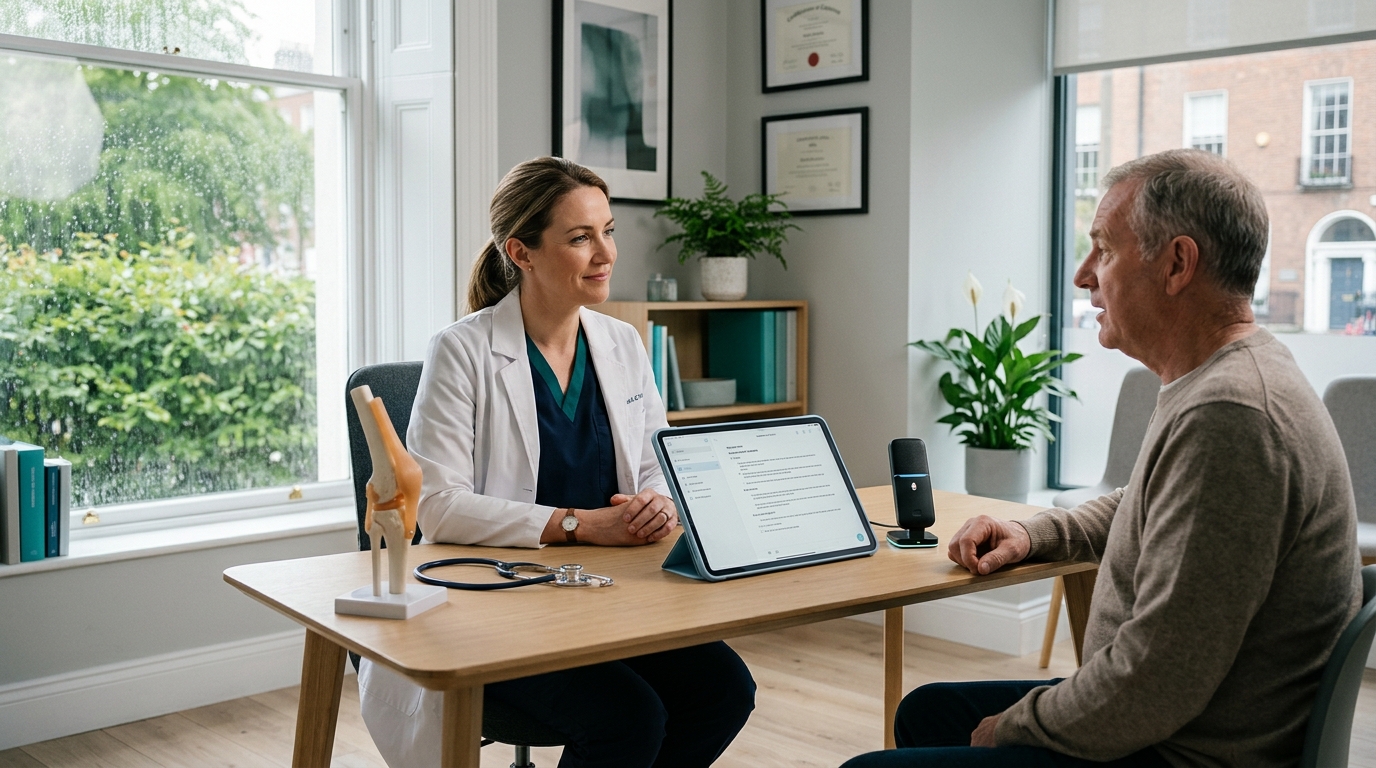
Integrating AI scribe software into a private practice requires a phased implementation focused on clinical workflows rather than IT disruption. Consultants should begin by running the software alongside existing dictation methods during routine outpatient clinics, gradually replacing legacy transcription services once accuracy and formatting meet their standards.
Adopting private orthopaedic surgeon software should not require a practice to halt its operations or undergo weeks of technical training. The most successful implementations occur when the technology is introduced gradually, allowing both the consultant and the administrative team to build confidence in the system's outputs. The goal is to augment the existing workflow, removing friction points without altering the fundamental way the consultant interacts with their patients.
A structured approach to implementation generally follows these phases:
- The Parallel Run: During the first week, the consultant continues to use their traditional dictaphone but simultaneously runs the ambient listening application on their smartphone or clinic computer during consultations. This allows the consultant to compare the AI-generated draft against their standard dictated letter, verifying that complex orthopaedic terminology and specific clinical nuances are captured accurately.
- Template Customisation: Once the baseline accuracy is established, the practice works to refine the output. This involves ensuring the AI maps the information into the consultant's preferred letterhead structure. For example, ensuring that the 'Diagnosis' is always bolded at the top, or that the 'Plan' section clearly delineates surgical intent from conservative management.
- Secretarial Workflow Shift: As the AI assumes the burden of initial drafting, the medical secretary's role evolves. Instead of spending hours audio-typing from scratch, the secretary becomes an editor and care coordinator. They review the AI drafts for formatting, append the necessary VHI or Laya pre-authorisation codes, and prepare the documents for the consultant's final electronic signature.
- Full Deployment across Sites: Because ambient AI is typically cloud-based and accessible via a mobile device, it is highly portable. Once the workflow is perfected in the main consulting rooms, the consultant can easily use the same application during satellite clinics at other private hospitals, maintaining a consistent documentation standard regardless of location.
Platforms like MedProAI are designed specifically for the Irish private sector, acknowledging the realities of multi-site consulting and the necessity of strict data governance. By focusing on a phased rollout, practices can achieve the efficiency gains of automated documentation without the stress of a sudden operational overhaul. For a broader view of how technology is reshaping practice administration, review our complete comparison of practice management software in Ireland.
The Future of Orthopaedic Dictation and Patient Care in Ireland
The future of orthopaedic dictation and patient care in Ireland will transition from passive transcription to active clinical administration support. Advanced voice models will draft multi-disciplinary team referrals, populate national joint registry data, and generate patient-facing recovery summaries, allowing consultants to focus exclusively on surgical outcomes.
The trajectory of clinical documentation is moving away from merely recording what happened in a room toward actively facilitating the next steps in a patient's care pathway. In orthopaedics, where patient outcomes are heavily dependent on post-operative rehabilitation and adherence to protocols, the ability to generate clear, immediate documentation is vital. As voice technology matures, we will see systems capable of extracting specific data points during a consultation to automatically populate complex forms, such as those required by the Irish National Orthopaedic Register (INOR), reducing yet another layer of manual data entry.
This evolution in practice operations has a direct, positive impact on the patient experience. When a practice is no longer bogged down by dictation backlogs and administrative delays, the entire patient journey becomes smoother. This is where companion patient technologies become highly relevant. For instance, platforms that include a patient-facing application allow individuals to take control of their own administrative interactions with the clinic.
Through the MeetBrigid app, patients can book their follow-up appointments, pay their consultation bills directly from their phone, and complete essential intake forms before they even arrive at the clinic. Crucially, patients can view their post-operative instructions, physiotherapy protocols, and administrative documents directly within the app. They retain full control over their data, choosing exactly what information to share with the practice. This patient-first approach to administration removes the friction of lost paper handouts and missed phone calls. The derived benefit for the consultant is a significantly quieter front desk and a reduction in the coordination overhead required to manage a busy multi-site surgical practice.
Ultimately, the integration of advanced documentation tools and patient-controlled administration platforms allows the orthopaedic consultant to reclaim their time. By automating the routine aspects of clinical reporting and empowering patients to manage their own bookings and billing, specialists can dedicate their focus to complex surgical decision-making and patient care.
MedProAI offers a 7-day free trial for Irish practices—visit auth.medproai.com to try it.
Frequently asked questions about AI clinical notes orthopaedic surgeon Ireland
How do AI clinical notes handle complex orthopaedic terminology and measurements?
Advanced AI clinical scribes are trained on specialized medical vocabularies, enabling them to accurately capture complex orthopaedic terms, range-of-motion degrees, and specific orthopedic tests during a natural conversation.
Is patient consent required before using AI dictation tools in Ireland?
Yes, private consultants must obtain explicit patient consent before recording any consultation, in alignment with Irish Medical Council guidelines and GDPR.
Where is the audio data and transcribed text stored?
Compliant AI clinical note platforms host all data within secure EU-based servers, ensuring strict adherence to GDPR regulations and Irish healthcare data laws.
Can AI clinical notes generate structured SOAP notes for orthopaedic surgery?
Yes, these tools automatically structure ambient consultation audio into clear SOAP notes, separating subjective patient reports from objective physical exam findings.
Frequently Asked Questions
Ready to give Brigid the admin?
Request early access — founding practices are onboarding now. Or book a 30-minute walkthrough with our team to see Brigid run a workflow with your own data.
EU-hosted · GDPR · Founding-partner access · Cancel any time