Medico-Legal Risk & AI: Ireland's Private Consultant Guide 2026
Poor notes drive many Irish medical claims. Learn how AI-generated clinical documentation helps private consultants mitigate medico-legal risk in 2026.

Built in Dublin · GDPR · Early access
MedPro saves Irish clinicians 9–18 hrs every week.
The Growing Burden of Clinical Documentation and Medico-Legal Exposure in Ireland
The administrative burden of clinical documentation directly contributes to medico-legal risk for private consultants in Ireland. The State Claims Agency reported paying out €2.1 billion in clinical claims from 2012 to 2022. Incomplete or delayed records create vulnerabilities, and the time required for comprehensive notes competes directly with clinical duties, increasing the chance of error and exposure.
For a consultant urologist or any specialist operating across multiple private hospitals—such as the Beacon, Mater Private, and Blackrock Clinic—the documentation challenge is magnified. Each patient interaction generates a cascade of required outputs: a detailed clinical note, a letter back to the referring GP, potential onward referrals, and instructions for administrative staff. The pressure to complete these tasks for a full clinic list, often at the end of a long day, is immense. This is not simply a matter of inconvenience; it is a significant source of professional risk.
According to the Medical Protection Society's analysis, poor record-keeping is a factor in a substantial number of clinical negligence claims. The time lag between seeing a patient and finalising the note is a critical weakness. A note dictated and typed a week after a consultation is not contemporaneous. It relies on memory, which is fallible, and it can be challenged more easily in a legal setting. The core problem is that the traditional model—dictation, transcription by a medical secretary, review, and signature—is too slow and labour-intensive to keep pace with the demands of modern private practice.
This administrative drag has a direct financial cost beyond potential claims. It represents hours of consultant time that could be spent on clinical care, research, or personal recovery. It also translates into significant secretarial overhead. The constant cycle of chasing dictations, correcting transcriptions, and managing paper trails consumes resources that could be better deployed elsewhere in the practice. The increasing complexity of care and patient expectations only adds to this pressure, making comprehensive, contemporaneous documentation more critical than ever.
 ▶ Watch on YouTube
Why Delayed or Incomplete Consultation Notes Put Private Consultants at Risk
Delayed or incomplete consultation notes create significant medico-legal risk by undermining the credibility and accuracy of the clinical record. In the event of a complaint or claim, records that are not contemporaneous are viewed as less reliable. They are vulnerable to accusations of being self-serving or based on flawed recall, weakening a consultant's defence and increasing liability.
The Medical Council of Ireland's Guide to Professional Conduct and Ethics is unequivocal on the importance of maintaining accurate and up-to-date records. Paragraph 35.1 states, "You must keep accurate and up-to-date patient records and notes of your consultations, investigations, referrals and treatments." The term 'up-to-date' is key. A note finalised days or weeks after the event fails this test. This delay introduces several specific risks:
- Recall Bias and Omission: Memory is notoriously unreliable. Details from a busy clinic blur. A consultant might forget a specific negative finding they checked for, a key piece of advice given about side effects, or the exact rationale for choosing one treatment pathway over another. If it is not in the note, for medico-legal purposes, it did not happen.
- Loss of Evidentiary Strength: Contemporaneous notes are considered a reliable account of events. A delayed note can be portrayed as an attempt to reconstruct events with the benefit of hindsight, particularly if an adverse outcome has occurred in the interim. This can fatally undermine a consultant's position.
- Continuity of Care Failures: Incomplete notes compromise patient safety. If a colleague is covering or a patient is seen in a different setting (e.g., an emergency department), an incomplete record can lead to misinformed decisions, repeated investigations, or missed follow-ups.
Consider a common urology scenario: a patient is reviewed with a borderline PSA result. The consultant discusses the risks and benefits of surveillance versus immediate biopsy, and the patient opts for surveillance with a repeat test in six months. If the detailed consent discussion and the specific rationale are not documented immediately, and the patient later develops advanced prostate cancer, the consultant's defence rests on their memory of a conversation that happened months or years prior. A contemporaneous, detailed note is the only solid defence.
Myth vs. Reality: Common Justifications for Delayed Notes
Myth: "I have an excellent memory. I'll dictate all my notes accurately at the end of the week."
Reality: The Ebbinghaus forgetting curve, a foundational concept in psychology, demonstrates that individuals forget approximately 50% of new information within an hour, and 70% within 24 hours. Relying on memory after a full week of clinics is a significant and uninsurable risk. Details, nuances, and specific patient questions will be lost.
Myth: "My medical secretary types everything up. The system works."
Reality: This process introduces a significant time lag. The delay between dictation, transcription, consultant review, and final sign-off can easily stretch to over a week. This multi-step process also introduces potential for transcription errors, which, if not caught during review, become part of the permanent record. This system is a known bottleneck, a point explored in our guide to automating post-operative letters for surgeons.

How AI-Powered Clinical Scribes Secure Contemporaneous, High-Quality Notes
AI-powered clinical scribes mitigate medico-legal risk by creating an accurate, structured draft of the clinical note instantly from the patient consultation. This allows the consultant to review, edit, and finalise the record contemporaneously, while the details are still fresh. This 'human-in-the-loop' model eliminates recall bias and ensures the final note is a reliable, defensible document.
These tools use ambient listening technology to capture the natural conversation between the consultant and patient. The AI then processes this conversation to generate a structured clinical note, typically in a SOAP (Subjective, Objective, Assessment, Plan) format. Crucially, the AI does not make clinical decisions or finalise the record. Its role is to handle the administrative task of drafting, leaving the consultant in complete control of the final clinical content. The consultant’s role shifts from laborious dictation to efficient review and verification.
This approach directly addresses the core failures of traditional documentation methods. The note is generated in real-time or immediately after the consultation, satisfying the requirement for contemporaneous records. Because it is based on the actual conversation, it captures subtleties and details that are easily forgotten. The risk of omission is drastically reduced.
Worked Example: Urology Consultation for BPH
Imagine a consultation with a 65-year-old male patient presenting with lower urinary tract symptoms (LUTS) secondary to benign prostatic hyperplasia (BPH). The conversation covers his IPSS score, urinary frequency, nocturia, flow rate concerns, a discussion of medical management (alpha-blockers, 5-alpha reductase inhibitors) versus surgical options (TURP, UroLift), and the associated risks and benefits of each.
- During Consultation: An ambient AI scribe, like MedProAI's Brigid, listens securely in the background.
- Immediately Post-Consultation: Before the consultant even moves to their desk, a draft SOAP note appears on their screen.
- Subjective: Accurately summarises the patient's reported symptoms, IPSS score, and quality of life impact.
- Objective: Notes findings from the physical exam (e.g., DRE findings) and any reviewed results (e.g., PSA, uroflowmetry).
- Assessment: Correctly identifies LUTS secondary to BPH.
- Plan: Details the shared decision-making process. It outlines the discussion of Tamsulosin versus a potential TURP, the specific side effects mentioned (e.g., retrograde ejaculation), the patient's preference for a trial of medication, and the plan for a follow-up appointment in 3 months.
- Consultant Review (2 minutes): The urologist reads the draft. They might add a specific nuance, such as "Patient particularly concerned about sexual side effects," and confirm the prescription details. They then sign off on the note.
The entire process takes less than five minutes. The result is a comprehensive, accurate, and contemporaneous record that provides a powerful defence against any future claim regarding inadequate consent or negligent advice. The time saved, multiplied across a full clinic, is substantial, but the primary benefit is the dramatic reduction in clinical documentation risk.
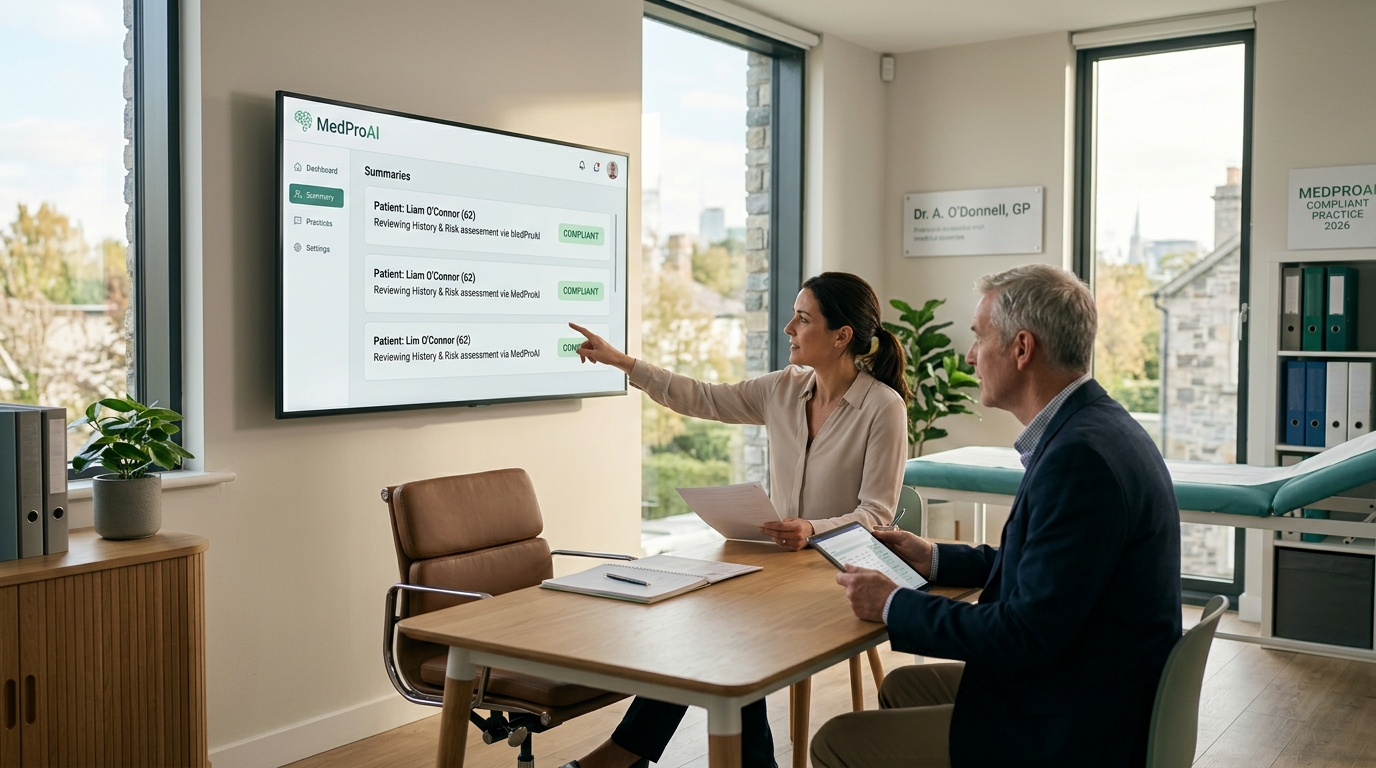
Best Practices for Integrating Compliant AI Tools into Your Irish Private Practice
To safely integrate AI scribes and mitigate medico-legal risk in an Irish context, consultants must prioritise tools that are GDPR-compliant, host data within the EU, and operate on a strict 'human-in-the-loop' principle. The selection process should involve a thorough due diligence checklist focused on data security, clinical oversight, and vendor transparency to ensure compliance with Medical Council and HIQA standards.
Adopting any new technology, especially one that handles sensitive patient data, requires a structured approach. The goal is to harness the efficiency of AI without introducing new liabilities. The emerging landscape of medico-legal risk and AI in Ireland demands careful navigation. The responsibility for the patient record remains, at all times, with the clinician. The AI is a tool, not a replacement for professional judgement.
Before committing to a platform, use the following checklist to assess its suitability for your private practice:
AI Integration Checklist for Irish Consultants
-
Data Residency and GDPR Compliance:
- Question: Where is my patient data stored?
- Requirement: The vendor must confirm that all patient data is processed and stored on servers located within the European Union. Hosting in Dublin (e.g., on AWS or Azure EU West regions) is the gold standard. This is non-negotiable for compliance with GDPR. Ask for the vendor's Data Processing Addendum (DPA). A vendor's inability to provide this is a major red flag. For more detail on compliance, the Data Protection Commission's guidance is the definitive resource.
-
The 'Human-in-the-Loop' Principle:
- Question: Who has final sign-off on the clinical note?
- Requirement: The system must be designed so that an AI-generated note is always a draft. The consultant must personally review, edit if necessary, and explicitly approve the final record. The platform should have a clear audit trail showing who created, edited, and finalised each entry. Avoid any tool that suggests autonomous note-finalisation.
-
Clinical Accuracy and Speciality Focus:
- Question: Does the AI understand my speciality's terminology?
- Requirement: A generic AI may struggle with the specific terminology of urology, cardiology, or psychiatry. Enquire if the model has been trained on medical-specific language. During a trial period, test it with complex cases unique to your field—for a urologist, this could be discussing Gleason scores, TRUS biopsy protocols, or urodynamics results.
-
Transparency and Explainability:
- Question: Can I access the original source of the AI's summary?
- Requirement: A trustworthy system should allow you to review the original audio recording or transcript alongside the generated note. This is crucial for verification and for understanding how the AI reached its conclusions, which can be vital if a record is ever scrutinised.
-
Integration with Existing Systems:
- Question: How does this fit with my existing practice management software?
- Requirement: The tool should ideally integrate with your current patient administration system to avoid creating data silos. Smoothly transferring the finalised note into the patient's main record is essential for workflow efficiency. Assess how it fits with your overall tech stack, a topic covered in our comparison of practice management software.
By systematically working through these points, a private consultant can confidently select an AI documentation tool that enhances efficiency while reinforcing, rather than weakening, their medico-legal standing. The reduction in clinical documentation risk in Ireland is achievable, but it requires diligent selection of the right technology partner.
Your immediate next step is to conduct a simple audit. For your next clinic, measure the time between seeing your last patient and signing off on the final clinical note for that session. If that gap is measured in days, not minutes, your practice has a significant and correctable medico-legal vulnerability.
MedProAI offers AI-powered practice management designed for Irish private consultants, with all data hosted in Dublin. It provides a secure, compliant way to eliminate documentation delays. Visit to start a 7-day free trial.
Frequently asked questions about medico-legal risk AI Ireland
How does AI clinical documentation reduce medico-legal liability for Irish consultants?
AI tools generate highly detailed, structured, and contemporaneous notes immediately after a patient visit. This reduces the risk of omitted details and recall bias, which are common vulnerabilities in Irish medical negligence cases.
Are AI-generated clinical notes compliant with Irish GDPR and Medical Council guidelines?
Yes, provided the AI tool is GDPR-compliant, hosts data within the EU, and the consultant reviews and signs off on every note. The clinician remains ultimately responsible for the accuracy of the record.
Can AI notes be used as evidence in an Irish High Court or Medical Council inquiry?
Yes, contemporaneous clinical notes are critical evidence in legal proceedings. Detailed, timely notes generated with AI assistance help prove the standard of care was met.
Frequently Asked Questions
Ready to give Brigid the admin?
Request early access — founding practices are onboarding now. Or book a 20-min walkthrough with our team to see Brigid run a workflow with your own data.
EU-hosted · GDPR · Founding-partner access · Cancel any time