How to Streamline the Patient Check-In Process in Dublin Private Clinics
Learn how to streamline patient check-in process Dublin clinics use to cut admin time. Discover AI tools & smartphone check-ins to reduce errors & improve flow.
Researched and written by MedPro's AI pipeline and published automatically — not individually reviewed by a person. Useful as a starting point; check clinical, legal and regulatory details against a primary source before relying on them.

Built in Dublin · GDPR · Early access
MedPro saves Irish clinicians 9–18 hrs every week.
Imagine it's 4:30 PM on a Tuesday in your Dublin city clinic. The waiting room is overflowing, your secretary is buried under a mountain of paper forms, and you're already bracing for another "stolen evening" spent fixing manual data entry errors. You aren't alone in this exhaustion. Many practitioners across Ireland are searching for how to streamline patient check-in process Dublin clinics require to stay competitive. You know that every minute spent on repetitive admin is a minute taken away from the actual care your patients deserve.
It's time to reclaim your time and restore balance to your practice. This guide provides a step-by-step framework to transform your front desk into a silent, efficient hub using modern, AI-driven workflows. You'll discover how to implement smartphone check-ins and automated syncing with clinical notes to eliminate bottlenecks for good. We'll explore how Brigid, our dedicated AI assistant built specifically for the Irish medical landscape, can handle the heavy lifting while ensuring full compliance with the Data Protection Act 2018 and GDPR standards. From reducing secretary burnout to improving patient flow, you're about to see how technology can finally feel supportive rather than burdensome.
Key Takeaways
- Eliminate waiting room bottlenecks by shifting to a digital path that starts 24 hours before the consultation.
- Discover how to streamline patient check-in process Dublin clinics can use to reclaim "stolen evenings" and reduce manual entry errors.
- Compare manual, kiosk, and AI-integrated solutions to find the most efficient fit for your limited clinic space.
- Stay compliant with Irish Data Protection Commission (DPC) standards by implementing end-to-end encryption for all patient intake.
- Audit your current administrative load to identify the specific local bottlenecks slowing down your clinical practice growth.
The Waiting Room Bottleneck: Why Dublin Clinics Need Digital Evolution
A truly streamlined patient check-in process is more than a simple greeting at a desk. It's a seamless digital path that begins the moment a booking is confirmed and ends only when the consultation starts. In Dublin, the reality for many private clinics is a constant battle with limited physical space. Whether you're operating out of a Georgian terrace or a compact suburban suite, an overcrowded waiting room creates immediate friction. Patients in 2026 have high expectations. They want modern, efficient service that respects their time. When your front desk is bogged down by paper forms, your clinical flow suffers.
Manual check-ins are the primary culprits behind "stolen evenings." This is precisely why modern patient intake software solutions have become essential for Irish practices. Every handwritten form requires manual data entry, often forcing practices to rely on outdated systems. Many Dublin clinics still depend on legacy Lanas Healthcare alternatives that weren't designed for modern digital workflows. manual data entry, which inevitably leads to errors in patient records or billing details. This administrative drag doesn't just stay at the front desk; it follows you into the consultation room. Friction at the entrance leads to delays in clinical documentation, pushing your entire schedule back. Many practitioners are now investigating how to streamline patient check-in process Dublin clinics can implement to stop this cycle of administrative catch-up. By removing the physical bottleneck, you reclaim the time needed for actual patient care.
The True Cost of Manual Intake
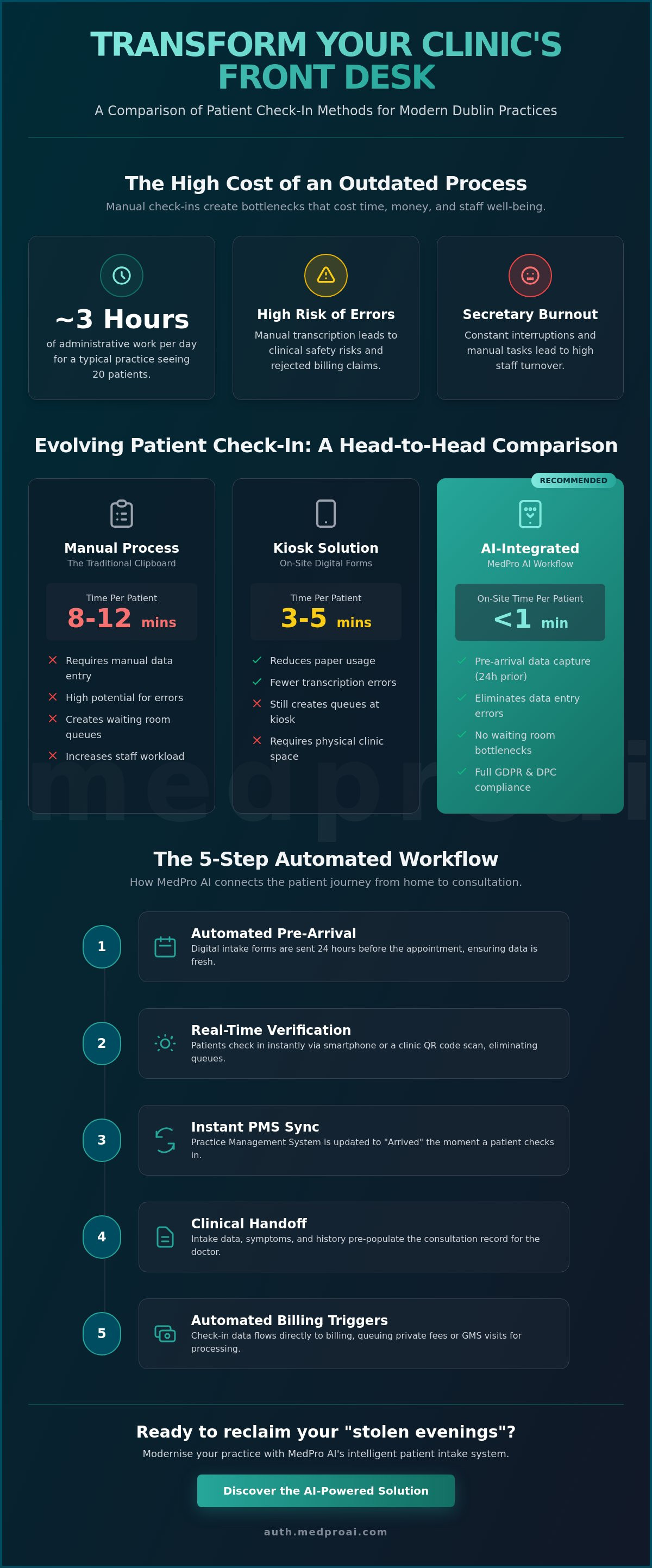
The minutes lost to paper-based systems add up quickly. On average, a manual intake takes 8 to 12 minutes per patient when you account for form filling, ID verification, and data entry. In a busy Dublin practice seeing 20 patients a day, that's nearly three hours of administrative weight. Transcription errors are common, leading to clinical safety risks and rejected medical billing claims. Your medical secretary also pays a psychological price. Facing constant telephone interruptions while trying to manage a queue of frustrated patients leads to rapid burnout and high staff turnover.
Patient Expectations in 2026
Dublin patients now expect the same digital ease they find in banking or travel apps. They don't want to handle shared clipboards or sit in cramped waiting rooms. A "digital-first" intake process significantly improves your clinic's reputation and helps with patient retention. By shifting from physical waiting rooms to virtual check-in queues, you provide a safer, more professional environment. Patients can wait in their car or a nearby cafe, receiving a notification only when you are ready to see them. This modern approach shows you value their comfort as much as their health.
Adopting these workflows isn't just about being "high-tech." It's about survival in a competitive market. When you understand how to streamline patient check-in process Dublin practices effectively, you move from reactive fire-fighting to proactive practice management. You deserve a clinic that runs like clockwork, and your patients deserve a stress-free start to their visit.
A 5-Step Framework to Streamline Patient Check-In
Modernizing your clinic requires more than just a digital version of a paper form. It demands a cohesive loop that connects the front desk to the consultation room and the billing office. If you're looking for how to streamline patient check-in process Dublin clinics can actually manage, you need a framework that respects both your time and your patients' privacy. This 5-step process moves beyond simple notifications to create a fully integrated clinical workflow.
- Step 1: Automated Pre-Arrival. Send digital intake forms exactly 24 hours before the appointment. This ensures data is fresh and reduces last-minute scrambles.
- Step 2: Real-Time Verification. Patients verify their arrival via a smartphone or a quick QR code scan upon entering the clinic. This eliminates the physical queue at the desk.
- Step 3: Instant PMS Sync. Your Practice Management System updates the patient status to "Arrived" the second they check in. No internal phone calls or shouting down hallways are required.
- Step 4: Clinical Handoff. Intake data, including symptoms and history, pre-populates your consultation record. You start the session with the essential facts already in front of you.
- Step 5: Automated Billing Triggers. The check-in data flows directly into the billing module. This ensures that GMS visits or private fees are queued for processing without manual re-entry.
Pre-Arrival: Capturing Data Early
Collecting medical history and insurance details before the patient steps through your door is a game-changer. Interactive confirmations do more than remind; they engage. When patients provide their details in advance, "no-shows" drop significantly because the commitment is already made. For Irish practitioners, integrating with Healthlink ensures the secure, encrypted transfer of referrals and patient data directly into your system. This proactive approach means your staff aren't spending their mornings chasing missing information. You can start automating these intake steps today to see an immediate reduction in administrative weight.
In-Clinic: The 'Silent' Reception Desk
Small Dublin practices often struggle with cramped waiting areas where privacy is hard to maintain. A "silent" reception desk solves this. By using QR code check-ins, you remove the need for patients to announce their details at a counter. Virtual waiting rooms allow patients to wait comfortably nearby, perhaps in a local cafe, until you're ready. You receive a notification the moment they're "Ready," allowing for a calm, professional transition into the consultation. This doesn't just save time; it restores a sense of clinical professionalism that manual systems often strip away.
Comparing Check-In Solutions: Manual vs. Kiosk vs. AI-Integrated
Choosing the right tool is the difference between a thriving practice and one drowning in paperwork. When you evaluate how to streamline patient check-in process Dublin practitioners often consider three distinct paths. Each has its own cost profile and a long-term impact on your mental energy. Manual systems are the most common but also the most expensive. You're paying for medical secretary time to handle clipboards and re-type data. Errors are inevitable, and patient satisfaction drops when they're stuck in a physical queue. In a city where time is at a premium, these delays are costly.
Physical kiosks were once seen as the solution, but they come with hidden burdens. They require valuable floor space in compact Dublin city clinics. They also demand regular sanitization and ongoing technical maintenance. If a screen breaks, your entire check-in flow grinds to a halt. AI-integrated solutions, like MedPro AI, offer a leaner approach. There is zero hardware to buy or fix. It uses the technology patients already carry in their pockets to create a seamless loop. It doesn't just mark a patient as arrived; it prepares your workflow and ensures GDPR compliance from the first tap.
Why Hardware-Free is the Future
Physical hardware is a liability in a busy clinical setting. Maintenance contracts and "out of order" signs shouldn't be part of your working day. By leveraging the patient's own smartphone, you create a truly contactless experience that patients find intuitive. SaaS subscriptions are predictable and scalable, unlike one-time hardware purchases that become obsolete within 24 months. You don't need a large capital outlay for tablets or stands. This allows you to scale from a single-doctor room to a multi-practitioner clinic without adding a single piece of equipment to your inventory.
The Brigid AI Advantage
Brigid AI acts as your tireless, local assistant. She uses the initial check-in data to provide vital context for automated clinical notes. Because she is "Irish Accent Optimised," she understands the specific linguistic nuances of your Dublin consultations. This integration means you aren't just checking a box; you're building the foundation of the entire patient record without lifting a finger. Partnering with MedPro AI allows you to reclaim your evenings by ensuring that the administrative work is finished the moment the patient leaves your room. It's a modern solution built for the specific regulatory and cultural realities of Irish private practice.
Navigating GDPR and Data Privacy in Dublin Private Practices
Security is not a luxury. In the Irish medical landscape, it is a strict legal requirement. The Data Protection Act 2018 and the General Data Protection Regulation (GDPR) dictate how you must handle sensitive health data. For many, the shift from paper to digital feels daunting. However, manual systems are often your greatest vulnerability. Paper forms left on a desk or filed in unlocked cabinets represent a significant risk. When practitioners research how to streamline patient check-in process Dublin clinics must prioritize a system that builds compliance into every step.
A robust digital intake relies on end-to-end encryption. This ensures that from the moment a patient enters their details on a smartphone until that data hits your clinical notes, it remains unreadable to unauthorized parties. You also need to capture and log digital consent. In Ireland, the age of digital consent is 16; your system must reflect this reality. MedPro AI includes a dedicated GDPR Compliance Module. This tool automates the logging of consent and minimizes your clinic's liability by creating a permanent, unalterable audit trail. It's about protecting your practice as much as your patients.
Data Sovereignty and Irish Hosting
Being "Built in Ireland" provides more than just cultural relevance; it offers regulatory peace of mind. Generic messaging apps like standard WhatsApp are not healthcare-specific. They often store data on servers outside the EEA, which can lead to complex legal headaches. Using a platform designed for the Irish market ensures your data stays within the appropriate jurisdiction. This sovereignty is essential for maintaining trust with your patients and the Data Protection Commission (DPC). It ensures you always have a clean audit trail for every patient interaction.
Staff Training for Digital Privacy
Moving medical secretaries from paper files to secure cloud access is a vital transition. It replaces physical clutter with tiered access levels. Only authorized staff see what they need to see. This makes handling Subject Access Requests (SARs) significantly easier. Instead of spending hours digging through paper archives, you can generate a complete record of a patient's data interactions in minutes. Training your team on these AI-driven tools doesn't just improve efficiency. It empowers them to be guardians of patient privacy. You can secure your practice today and stop worrying about the complexities of data regulation.
Implementation Guide: Modernising Your Dublin Practice Workflow
Transitioning to a digital-first model doesn't happen by accident. It requires a deliberate audit of your current front-desk habits. Start by measuring the exact time your staff spends on manual intake. As we noted previously, this often exceeds 10 minutes per patient. By identifying these specific local bottlenecks, you can see exactly where how to streamline patient check-in process Dublin clinics effectively begins. Your choice of a practice management system is the foundation. It must integrate scheduling and billing into a single, cohesive loop to prevent data silos.
Brigid AI plays a central role in this transformation. She doesn't just record an arrival; she takes the data captured during check-in and uses it to frame your consultation. This means your clinical documentation is already partially finished before you even greet the patient. This connectivity is what separates a modern practice from one still tethered to paper. Setting a clear timeline for staff onboarding and patient communication ensures that everyone is aligned and ready for the shift.
The 30-Day Modernization Roadmap
Modernizing a busy Dublin clinic works best when broken into manageable phases. This four-week plan ensures a smooth transition without disrupting your daily consultations:
- Week 1: Configuration. Focus on data migration and software setup tailored to your specific clinic needs.
- Week 2: Staff Training. Your team learns the Brigid AI documentation interface, moving away from repetitive data entry.
- Week 3: Patient Rollout. Introduce QR codes and digital instructions in your waiting area to guide patients through the new process.
- Week 4: Optimization. Review your time-savings and fine-tune the automated billing cycle to ensure maximum efficiency.
Reclaiming Your Evenings with MedPro AI
The true value of this digital evolution is the palpable sense of relief you feel at the end of the day. There is a unique satisfaction in leaving the clinic on time with your notes fully completed. You didn't enter the medical profession to be an administrator; you entered it to care for people. By letting AI handle the "admin of medicine," you're free to focus entirely on the "art of medicine."
It's time to stop the cycle of stolen evenings and manual errors. Your practice deserves a system that is tireless, reliable, and built specifically for the Irish healthcare community. You can take the first step toward a more balanced professional life right now. We invite you to book a demo with MedPro AI and see how Brigid can transform your daily workflow.
Restore Balance to Your Private Practice
The path to a more efficient clinic is clear. By moving beyond manual paperwork and bulky kiosks, you can transform your front desk into a silent hub of productivity. You now understand the essential steps for how to streamline patient check-in process Dublin clinics need to stay competitive while meeting strict DPC standards. This isn't just about software; it's about reclaiming the "stolen evenings" spent on administrative catch-up and refocusing on your patients.
MedPro AI is built in Dublin specifically for the Irish medical landscape. Our system is Irish Accent Optimised and includes a fully GDPR compliant module to give you total peace of mind. Brigid AI acts as your tireless assistant, ensuring your clinical documentation is finished the moment your last patient leaves. You don't have to face the administrative burden alone anymore.
Book a demo with MedPro AI to reclaim your evenings today.
Your time is valuable. Start building the modern, stress-free practice you and your patients deserve.
Frequently Asked Questions
Is digital check-in GDPR compliant for private clinics in Ireland?
Yes, digital check-in is fully compliant when it utilizes end-to-end encryption and automated consent logging. Our system is built to meet the strict standards of the Data Protection Act 2018 and the Irish Data Protection Commission. By moving away from paper forms, you actually reduce the risk of data breaches associated with physical records left in public waiting areas.
How do elderly patients in Dublin react to smartphone-based check-in?
Most patients find QR codes surprisingly intuitive. While roughly 12% of patients may still prefer traditional assistance, the digital system handles the vast majority of arrivals automatically. This frees up your medical secretary to provide dedicated, unhurried support to those who need it most. It creates a calmer environment for everyone, regardless of their comfort level with technology.
Can MedPro AI integrate with my existing medical billing software?
Yes, our system is designed to bridge the gap between patient arrival and final payment. Check-in data flows directly into our automated medical billing module, ensuring that GMS visits and private fees are processed without manual re-entry. This integration eliminates the transcription errors that frequently lead to rejected claims and delayed payments in busy Dublin practices.
What happens if a patient arrives without a smartphone?
Your medical secretary can still perform a manual check-in for any patient without a device. However, since 88% of adults in Ireland now use smartphones daily, the digital system manages the bulk of your patient flow. This prevents the front-desk bottlenecks that usually occur during peak morning and afternoon periods, allowing your staff to focus on exceptional cases.
Does streamlining the check-in process actually reduce physician burnout?
Yes, because a better start to the patient journey leads to a better finish. When you learn how to streamline patient check-in process Dublin clinics can manage effectively, you prevent the administrative "snowball" effect. Data captured at check-in pre-populates your clinical notes, ensuring you finish your documentation during the consultation rather than during your "stolen evenings" at home.
How long does it take to train staff on the new AI workflow?
Most teams become comfortable with the new system within five to seven working days. As outlined in our 30-day modernization roadmap, we dedicate the second week specifically to staff training. The interface is designed to be punchy and benefit-driven, making it much simpler to use than traditional, high-maintenance practice management software or physical kiosks.
Is the system 'Irish Accent Optimised' for clinical documentation?
Yes, Brigid AI is specifically tuned to recognize the nuances of Irish accents and local medical terminology. This optimization is a core part of our "Built in Ireland" identity. It ensures that the transition from check-in data to finished clinical notes is accurate and requires minimal correction, which is essential for maintaining a fast-paced clinical rhythm.
Can I use this system for multi-doctor practices with different schedules?
The system is fully scalable and designed for multi-practitioner environments. You can manage separate schedules and consultation rooms from a single, organized dashboard. This provides real-time status updates for every doctor in the building, ensuring that the entire team knows exactly when their next patient has arrived and is ready to be seen.
Frequently Asked Questions
Ready to give Brigid the admin?
Request early access — founding practices are onboarding now. Or book a 30-minute walkthrough with our team to see Brigid run a workflow with your own data.
EU-hosted · GDPR · Founding-partner access · Cancel any time