HIPAA vs GDPR Compliance for Irish Clinics: The Definitive 2026 Guide
Struggling with HIPAA vs GDPR compliance for Irish clinics? This 2026 guide explains key differences, data residency risks, and how to avoid costly DPC fines.
Researched and written by MedPro's AI pipeline and published automatically — not individually reviewed by a person. Useful as a starting point; check clinical, legal and regulatory details against a primary source before relying on them.

Built in Dublin · GDPR · Early access
MedPro saves Irish clinicians 9–18 hrs every week.
Is your "HIPAA-compliant" software actually leaving your Dublin clinic vulnerable to a €20 million fine? Many Irish practitioners assume that if a tool is secure enough for the US, it’s safe for the Data Protection Commission (DPC), but that misconception is a dangerous gamble. Understanding HIPAA vs GDPR compliance for Irish clinics is no longer optional; it’s a survival skill in a landscape where the DPC recently processed over 7,781 valid data breach notifications in a single year. You’ve worked too hard to let a terminology mix-up steal your peace of mind or your practice's revenue.
We know you’re exhausted from manual auditing and the constant fear of a 4% turnover penalty. You deserve a tech stack that works as hard as you do without demanding your weekends in return. This guide clarifies your legal obligations in Ireland for 2026 and provides a concrete checklist for your current software. We’ll also show you how Brigid, our AI assistant built right here in Ireland, automates the heavy lifting of GDPR so you can finally reclaim your evenings and focus on your patients.
Key Takeaways
- Understand why HIPAA certification doesn't provide a legal "safe harbour" in Ireland and where your actual liabilities lie under GDPR.
- Navigate the critical differences in HIPAA vs GDPR compliance for Irish clinics, specifically the strict 72-hour breach reporting window versus the US 60-day rule.
- Identify the "Data Residency" risks that could trigger DPC investigations if your software stores patient files outside the European Union.
- Audit your current tech stack with a practical checklist to ensure every tool in your clinic meets 2026 Irish regulatory standards.
- Discover how Brigid AI automates your documentation and compliance auditing so you can stop "stealing your evenings" for administrative paperwork.
The Regulatory Landscape for Private Clinics in Ireland
Running a private practice in Dublin or Cork involves balancing patient care with an ever-growing mountain of administrative paperwork, from GDPR compliance documentation to VHI and Laya Healthcare billing processes. While you might see "HIPAA Compliant" badges on almost every piece of medical software you research, that label doesn't offer you a legal shield in Ireland. Here, the General Data Protection Regulation (GDPR) is the only law that matters for protecting patient privacy. Understanding HIPAA vs GDPR compliance for Irish clinics is the difference between a thriving practice and a devastating investigation. As of May 2026, the regulatory environment is more active than ever. The Irish Data Protection Commission (DPC) is no longer just focusing on big tech; they're looking at how local healthcare providers handle sensitive data.
The stakes are high. Serious infringements can lead to fines of up to €20 million or 4% of your total global turnover. Beyond the financial risk, a data breach destroys the trust you've built with your patients over decades. You need a partner who understands the local landscape. At MedProAI, we built our platform specifically for the Irish market to ensure you never have to choose between modern efficiency and legal safety.
The Role of the Data Protection Commission (DPC)
The DPC classifies medical records as "special category" data. This means your patient notes, GMS numbers, and treatment histories require the highest level of protection under the law. In 2024, the DPC received 11,091 new cases. This proves that patients are more aware of their rights than ever before. You act as the "data controller," which means you're legally responsible for how information is handled. Your software providers are "data processors." If your processor fails to meet EU standards, the DPC still holds you accountable. It's a heavy burden that often leads to "stolen evenings" spent auditing manual logs. We designed Brigid AI to handle these audits automatically, acting as a tireless assistant who never misses a compliance detail.
Why HIPAA is Mentioned so Often in Ireland
We hear about the Health Insurance Portability and Accountability Act (HIPAA) because US-based software dominates the global market. Many consultants mistakenly view it as the "gold standard" for security. While HIPAA provides excellent technical benchmarks for encryption and access controls, it's a US federal law with no jurisdiction in the EU. A "HIPAA compliant" tool might still store your data on servers in Virginia or California. This is a direct violation of GDPR data residency rules. In 2026, relying on US standards alone is a risk your clinic doesn't need to take. You need a solution built in Ireland, for Ireland, that keeps data within the EU and follows DPC guidelines to the letter.
Structural Differences: Global Privacy vs. US Health Portability
The philosophical divide between these two frameworks is vast. HIPAA was originally designed to streamline the US healthcare industry and ensure insurance portability. In contrast, the European Commission on Data Protection (GDPR) treats privacy as a fundamental human right. This distinction changes everything for your practice. While HIPAA is territorial and only applies within the US, GDPR is extra-territorial. It follows your patient. If a Dublin resident visits your clinic, their data is protected by GDPR regardless of where your server is physically located. When evaluating HIPAA vs GDPR compliance for Irish clinics, you must remember that GDPR covers all personal data, including IP addresses and contact details, whereas HIPAA focuses more narrowly on Protected Health Information (PHI).
Under GDPR, patients have a specific legal right to request the deletion of their personal data when it is no longer necessary for the purpose it was collected, a provision that does not exist within the HIPAA framework. This "Right to be Forgotten" can be a complex administrative hurdle for a busy consultant. You don't want to spend your Sunday afternoons manually scrubbing databases. Our GDPR compliance module handles these requests with clinical precision, ensuring you stay on the right side of the law without lifting a finger.
Data Subject Rights in the Irish Clinic
Handling a Subject Access Request (SAR) shouldn't feel like a localized disaster. Under GDPR, Irish patients have the right to see exactly what data you hold. You have 30 days to respond, often for free. In a manual system, this means hours of digging through files. Patients also have the right to rectification. You must be able to correct clinical notes quickly, provided you maintain a clear audit trail. Finally, data portability is a core requirement. Whether a patient is moving to a new GP in Galway or seeing a specialist in Dublin, their data must be transferable in a structured, machine-readable format. Brigid AI organises this documentation instantly, so you're always ready for a request.
Consent Models: Opt-in vs. Treatment-based
Consent is where many Irish clinics stumble. HIPAA often allows data sharing for "Treatment, Payment, and Operations" (TPO) without a signature. GDPR is much stricter. You need explicit, granular consent. This means your intake forms must clearly separate consent for clinical care from consent for marketing or third-party research. You can't bundle them together. If your digital scheduling tool doesn't capture these distinct permissions, you're at risk. We've designed our patient scheduling system to ensure every "opt-in" is recorded and timestamped. It's about protecting your practice while respecting the patient's choice. This level of detail is what separates a generic tool from a solution built for the Irish medical community.
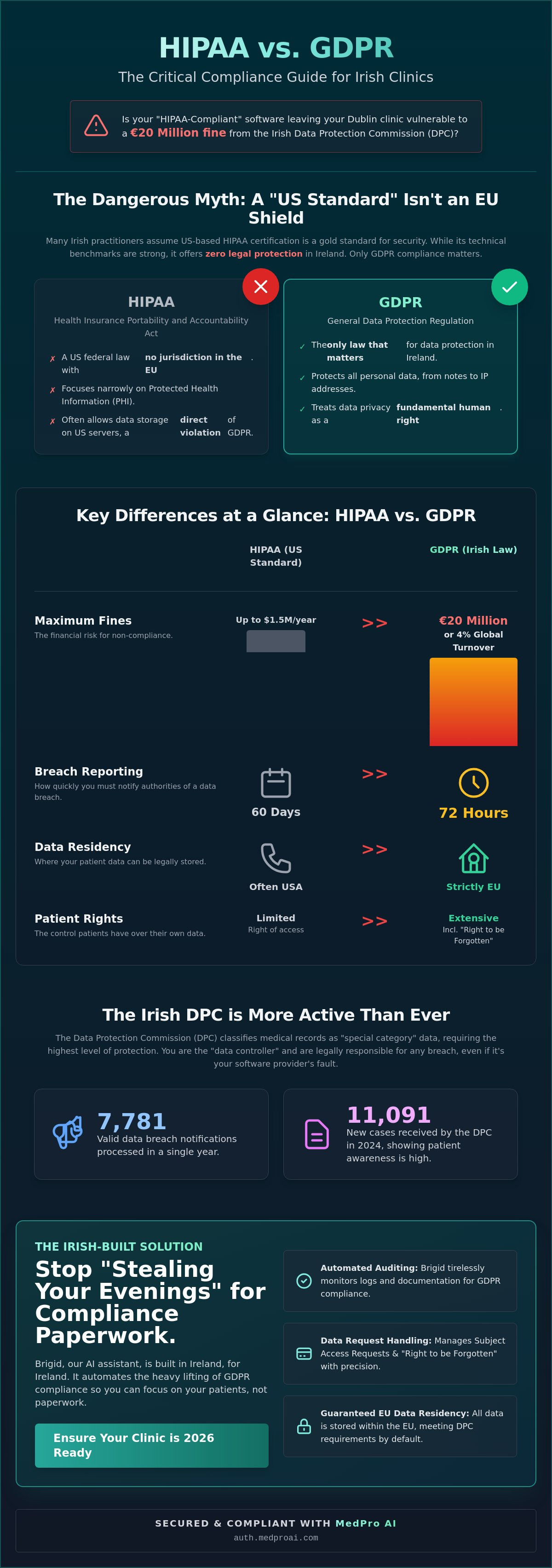
Side-by-Side Comparison: Data Rights, Consent, and Breach Reporting
When comparing HIPAA vs GDPR compliance for Irish clinics, the most striking difference is the timeline for crisis management. Under HIPAA, US entities often have up to 60 days to report a breach. In Ireland, the DPC demands action within 72 hours of discovery. This narrow window means you don't have time to wait for a US-based software provider to investigate an issue during their business hours. You need a local system that alerts you the moment an anomaly occurs.
| Feature | GDPR (Ireland) | HIPAA (US) |
|---|---|---|
| Scope | All personal data of EU residents | Protected Health Information (PHI) |
| Consent | Explicit, granular opt-in required | Implied for treatment and payment |
| Breach Notification | Within 72 hours to the DPC | Up to 60 days to HHS |
| Individual Rights | Includes Right to Erasure/Portability | Focused on Access and Amendment |
| Max Penalties | €20m or 4% of global turnover | $2.19 million (approx. €2.02m) |
A "Personal Data Breach" in an Irish context is broader than many realize. It isn't just a hacker stealing a database. It includes a receptionist accidentally emailing a prescription to the wrong patient or a consultant losing an unencrypted laptop on the Luas. These incidents trigger immediate legal obligations that can't be ignored.
Breach Notification Protocols for Dublin Practices
If a breach occurs, your first step is identifying if it poses a risk to the patient's rights and freedoms. If it does, you must notify the DPC via their online portal within that 72-hour limit. If the risk is high, you must also inform the affected patients directly. You are legally required to maintain a "Breach Register." This is a permanent record of every security incident, no matter how small. Brigid AI simplifies this by automatically logging access patterns and flagging potential risks, so your register is always audit-ready.
Penalties and the Cost of Non-Compliance
The financial penalties updated on January 28, 2026, show that HIPAA fines are significant, but they pale in comparison to GDPR. However, the real cost for an Irish consultant is often reputational. Ireland is a small medical community. A public inquiry by the DPC can damage patient trust faster than any fine. You also face hidden costs like mandatory forensic audits and practice downtime during an investigation. Ignorance isn't a defence. Relying on a "HIPAA compliant" badge from a foreign vendor won't stop the DPC from holding your clinic accountable for local failures.
Why "HIPAA Compliant" Isn’t Enough for a Dublin Clinic
You've likely heard the pitch before. A software provider promises their tool is the gold standard because it's "HIPAA compliant." While that badge sounds impressive, it's often a red flag for an Irish practice. HIPAA is a US federal law designed for the American healthcare system. It doesn't account for the specific demands of the Irish Data Protection Commission (DPC). Relying on US standards in a Dublin clinic is like using a US power plug in an Irish socket; the tech might be high quality, but it simply won't connect with the local reality. When we talk about HIPAA vs GDPR compliance for Irish clinics, we aren't just discussing security. We’re discussing your legal right to operate.
The DPC is becoming increasingly surgical in its oversight. On March 2, 2026, the commission published its final decision following an inquiry into the University of Limerick, proving that local institutions are under the microscope. If your software provider doesn't have a deep understanding of the Irish Health Act and DPC expectations, you're the one left answering the difficult questions. You need a partner who speaks the language of the Irish medical landscape, not just a generic global vendor.
The Problem with US-Based Cloud Servers
Data residency is a non-negotiable hurdle. Many HIPAA-compliant tools use cloud servers based in the US. Following the "Schrems II" ruling, transferring sensitive patient data across the Atlantic is a high-risk activity that often violates GDPR. As of May 2026, the average number of daily personal data breach notifications in Europe has risen by 22%. This increase makes the location of your patient records more critical than ever. At MedPro AI, we ensure all clinical data remains on EU-based servers. This eliminates the risk of illegal transatlantic transfers and keeps your practice safely within the DPC’s jurisdiction. It’s about more than ticking a box; it’s about ensuring your patients' most sensitive information never leaves the protection of EU law.
Local Integrations: Healthlink and Irish Billing
A tool built for the US market will never truly understand the rhythm of an Irish clinic. Most HIPAA-only software lacks integration with Healthlink, the backbone of clinical communication in Ireland. Without this, you're stuck manually uploading lab results or referrals, stealing your evenings and increasing the risk of data entry errors. Your billing needs are also unique. A US tool won't understand GMS visits, PCRS claims, or the specific requirements of Irish private insurers. You need a system that automates these local processes so you can reclaim your time. Before you commit to a new software, use this audit checklist:
- Hosting: Is the data stored exclusively within the European Union?
- Integration: Does it connect directly with Healthlink and Irish billing systems?
- Support: Is there a local team that understands DPC regulations and Irish practice management?
- Language: Is the AI "Irish Accent Optimised" to ensure clinical notes are accurate?
Don't settle for a generic solution that leaves you vulnerable to massive fines. Secure your practice with our GDPR-first platform today and experience the relief of a system built specifically for the Irish medical community.
Navigating Compliance with MedPro AI and Brigid
Legacy systems often feel like a second job. You finish your last consultation only to start a marathon of data entry and compliance checks. We built MedPro AI to end the era of "stolen evenings." While generic platforms force you to figure out HIPAA vs GDPR compliance for Irish clinics on your own, our system was born in the Irish regulatory environment. It doesn't just store data; it actively protects your practice. Our GDPR Compliance Module isn't an afterthought or a plugin. It's a core feature designed to meet the exact standards of the Data Protection Commission (DPC).
Brigid is our core technology. She is more than just an AI; she's a tireless assistant who is "always on" and never calls in sick. Because she is Irish Accent Optimised, she understands the nuances of a consultant's dictation in Dublin or a GP's notes in Galway. This precision is vital. In 2026, manual data entry errors remain a leading cause of data breaches. Brigid eliminates this risk by generating accurate clinical documentation in real-time. You get the clinical professionalism you require with the technical security you need.
How Brigid AI Automates Your GDPR Workflow
Handling a Subject Access Request (SAR) can take hours of manual searching and redaction. Brigid automates this process. She can generate comprehensive, structured patient records in a GDPR-compliant format with a single click. All data is housed in secure, encrypted storage that meets the highest Irish medical standards. This automation ensures you stay compliant without lifting a finger. By moving away from manual auditing, you can finally reclaim your time and focus on what matters most: your patients. Our GDPR Compliance Module acts as a digital shield, constantly monitoring your data patterns for any signs of irregularity.
Getting Started: A Risk-Free Transition
Moving from legacy systems like iMedDoc shouldn't be a headache. We understand the fear of losing decades of patient history during a migration. Our specialized team handles the entire data migration process for you. We ensure every record is transferred securely and mapped correctly into our GDPR-compliant framework. We also provide comprehensive training for your staff. We show them how to use Brigid’s AI documentation features to maintain perfect compliance every day. It's time to stop worrying about regulatory gaps and start growing your practice with a partner who understands the Irish medical landscape. Book a demo of Brigid AI and see our GDPR module in action today to see how we can restore balance to your professional life.
Future-Proof Your Practice Against DPC Scrutiny
Relying on US standards in a Dublin practice is a risk you don't need to take. While HIPAA offers technical security, only GDPR alignment protects you from the DPC’s €20 million penalties. We’ve explored how HIPAA vs GDPR compliance for Irish clinics hinges on data residency, explicit consent, and those critical 72-hour breach windows. You deserve a system that understands these nuances so you can stop stealing your evenings for administrative audits.
MedProAI provides the local expertise your practice requires. Our Dublin-based support team is always ready to help. Our AI, Brigid, is Irish Accent Optimised for clinical accuracy. With a built-in GDPR Compliance Module, we handle the legal heavy lifting without you lifting a finger. It's time to trade manual paperwork for modern efficiency and clinical peace of mind.
Reclaim your evenings with Brigid AI – The GDPR-compliant assistant for Irish doctors. Your practice is ready for the next level of care. We’re here to make sure your technology supports your growth without the administrative headache.
Frequently Asked Questions
Is HIPAA compliance valid in Ireland?
HIPAA compliance is not legally valid in Ireland and provides no "safe harbour" for your clinic. It is a US federal law designed for the American healthcare market. While it offers high security benchmarks, the Data Protection Commission (DPC) only recognizes GDPR. Relying on US standards alone leaves you open to the €20 million fine structure established for serious EU privacy violations.
What are the main GDPR requirements for a small private clinic?
You must have a lawful basis for processing data, which is usually for medical diagnosis or treatment. You're also required to maintain a Record of Processing Activities (ROPA) and provide a clear Privacy Notice to patients. Small clinics must also implement robust technical safeguards, such as encryption and multi-factor authentication. These steps ensure you meet the 2026 standards for HIPAA vs GDPR compliance for Irish clinics.
Do I need a Data Protection Officer (DPO) for my medical practice?
Most Irish medical practices require a DPO because they process "special category" health data as a core activity. While the DPC provides some flexibility for solo practitioners, any clinic with multiple consultants or high patient volume should appoint one. This person ensures your practice remains compliant with the latest 2026 regulatory updates. Brigid AI supports this role by providing automated logs and audit trails.
How long must I keep patient records under Irish GDPR?
Patient records should generally be kept for 8 years after the last contact, according to HSE and Medical Council guidelines. For children, records are typically kept until they reach age 25 or 26. GDPR requires that you don't keep data longer than necessary for the purpose it was collected. Our system includes automated retention policies to help you manage these timelines without manual auditing.
Can I use US-based software if it claims to be GDPR compliant?
Using US-based software is risky because of strict EU rules on transatlantic data transfers. Even if a provider claims compliance, the "Schrems II" ruling makes these transfers legally unstable. You'd need a Data Transfer Impact Assessment (DTIA) in place to be safe. It's much simpler to use a local partner like MedPro AI that hosts all clinical data exclusively on servers within the European Union.
What happens if a patient requests their data be deleted?
You must respond to a "Right to Erasure" request within 30 days. However, you can often refuse the request if the data is required for ongoing medical treatment or legal defense. You must provide a clear reason for any refusal in writing. Brigid AI simplifies this by helping you categorize data, making it easy to identify what can be deleted and what must be retained for clinical safety.
Is AI clinical documentation allowed under Irish privacy laws?
AI documentation is fully permitted as long as you maintain transparency and secure processing. You must ensure your AI partner doesn't use patient data to train global models without explicit consent. MedPro AI is built with a "privacy by design" approach. Our AI is Irish Accent Optimised and processes data locally within the EU, ensuring your clinical notes remain private and accurate.
How does MedPro AI ensure my patient data is hosted in Ireland/EU?
We host all patient information on dedicated servers located within the European Union. This eliminates the legal risks associated with HIPAA vs GDPR compliance for Irish clinics using US cloud providers. By keeping data local, we ensure your practice remains fully aligned with DPC expectations. This geographic certainty provides the relief you need to focus on patient care instead of server locations.
Frequently Asked Questions
Ready to give Brigid the admin?
Request early access — founding practices are onboarding now. Or book a 30-minute walkthrough with our team to see Brigid run a workflow with your own data.
EU-hosted · GDPR · Founding-partner access · Cancel any time