AI SOAP Notes for Orthopaedic Surgeons in Dublin: 2026 Time Savings
Dublin orthopaedic surgeons using AI clinical notes reduce dictation time to under two minutes per patient while maintaining strict GDPR compliance.
Researched and written by MedPro's AI pipeline and published automatically — not individually reviewed by a person. Useful as a starting point; check clinical, legal and regulatory details against a primary source before relying on them.

Built in Dublin · GDPR · Early access
MedPro saves Irish clinicians 9–18 hrs every week.
The documentation burden facing Dublin orthopaedic consultants
Dublin orthopaedic consultants spend approximately 2.5 hours daily on clinical documentation and referral letters. Multi-site private practices across the Beacon, Blackrock Clinic and Mater Private generate high volumes of post-operative notes, MRI requests and discharge summaries. This administrative load directly reduces available theatre time and limits new patient consultations.
The mathematics of private orthopaedic practice management Ireland reveal a structural inefficiency in how highly trained specialists allocate their time. A standard full-day outpatient clinic typically involves between 30 and 40 patient encounters. These range from rapid six-week post-operative reviews for total hip arthroplasties to complex, hour-long initial consultations for multi-ligament knee injuries. Each of these encounters generates a mandatory documentation requirement. If a consultant spends just four minutes dictating, reviewing and signing off on the notes and letters for each of those 40 patients, the total administrative time reaches 160 minutes per clinic.
Across a standard 40-week clinical year, a consultant running three full-day clinics a week loses over 300 hours to documentation. This is time extracted directly from potential operating theatre lists or additional consulting hours. According to workforce planning documents from the Royal College of Surgeons in Ireland (2023), administrative burden remains a primary constraint on surgical capacity. The physical act of recording clinical findings has become a bottleneck that limits practice growth and increases the overhead costs associated with medical secretarial support.
The financial implications of this documentation delay extend beyond the consultant's own time. When a clinic relies on traditional dictation, audio files are sent to a medical secretary for transcription. The secretary types the letters, which are then placed in a queue for the consultant to review, amend and finally sign. This multi-step process introduces a lag between the patient encounter and the finalisation of the clinical record. In a high-volume joint replacement practice, a backlog of unapproved letters can delay communication with referring GPs and slow down the pre-authorisation processes required by private health insurers like VHI, Laya Healthcare and Irish Life.
Insurer pre-authorisation for orthopaedic procedures demands highly specific documentation. When requesting approval for an arthroscopic meniscectomy or an anterior cruciate ligament reconstruction, the clinical notes must clearly demonstrate the failure of conservative management, the exact findings of the physical examination and the correlation with MRI results. If the initial consultation note lacks this structured detail because the consultant was rushing through a backlog of dictations, the insurer may query the request. This triggers a cycle of administrative friction where secretaries must request addendums to the notes, further delaying the patient's surgical admission.
The physical toll on the consultant is also measurable. After standing in theatre for a six-hour list, returning to a desk to clear a queue of 20 dictations is a recognised source of professional fatigue. The traditional workflow forces surgeons to context-switch constantly between clinical decision-making and administrative data entry. Finding a method to capture complex clinical information accurately at the point of care without adding to the physical workload is a primary objective for modern surgical practices.
 ▶ Watch on YouTube
How AI clinical notes structure complex joint assessments
AI clinical notes capture the specific nuances of joint assessments by automatically structuring spoken consultations into standard orthopaedic SOAP formats. The technology accurately categorises range of motion measurements, special test results like Lachman or McMurray tests, and complex surgical plans without requiring manual typing or separate dictation sessions.
The standard orthopaedic consultation is highly verbal and physically interactive. A consultant assessing a painful shoulder will ask the patient to move through various planes of motion while simultaneously describing the findings aloud. "Raise your arm up to the front. Okay, you have about 120 degrees of forward flexion before the pain stops you. Now push against my hand. Good strength in external rotation, but positive Neer and Hawkins signs." In a traditional workflow, the consultant must remember these specific data points and dictate them later, mentally translating the conversational assessment into a formal medical record.
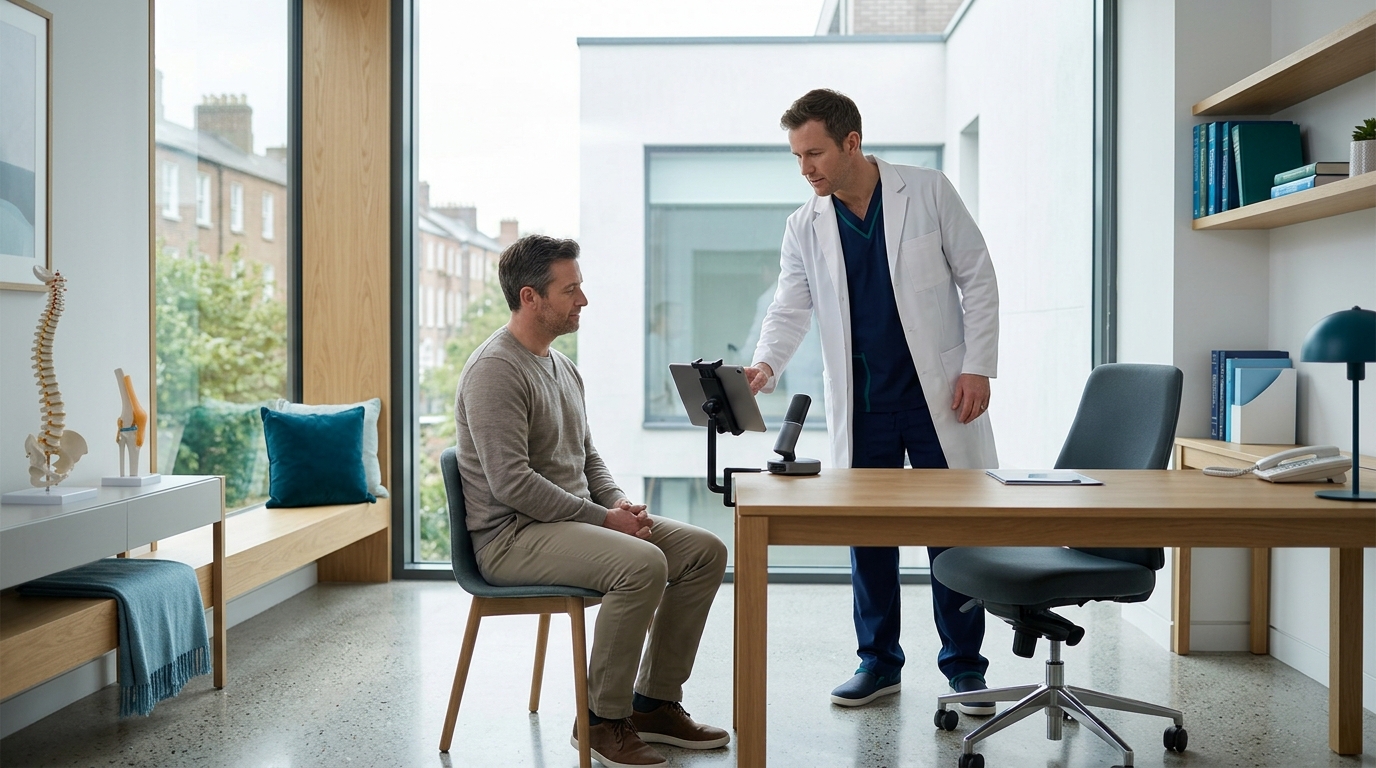
An AI scribe alters this process by functioning as an ambient listener in the consulting room. The software captures the natural dialogue between the surgeon and the patient, processing the medical terminology and the conversational context. It distinguishes between the patient's subjective description of their pain and the consultant's objective findings during the physical examination. The output is a formatted note divided into the Subjective, Objective, Assessment and Plan (SOAP) structure.
Consider the specific requirements for generating AI SOAP notes orthopaedic surgeon Dublin clinics need for accurate record-keeping. The subjective section automatically extracts the mechanism of injury, the duration of symptoms and previous treatments like physiotherapy or corticosteroid injections. The objective section captures the physical examination. If the surgeon states that the patient has a fixed flexion deformity of 15 degrees and medial joint line tenderness, the AI places these findings precisely in the examination paragraph. The assessment synthesises the diagnosis, such as moderate medial compartment osteoarthritis. Finally, the plan outlines the next steps, whether that is scheduling a targeted MRI, prescribing non-steroidal anti-inflammatory drugs or listing the patient for a high tibial osteotomy.
The ability to structure data accurately is particularly critical when dealing with complex, multi-site trauma or revision arthroplasty cases. These consultations often involve reviewing previous operation notes, discussing the wear patterns of existing prostheses and outlining the risks of revision surgery. An AI tool trained on medical terminology recognises terms like 'aseptic loosening', 'polyethylene wear' and 'osteolysis'. It formats the discussion of surgical risks, ensuring that the patient's verbal acknowledgement of potential complications like infection, nerve damage or deep vein thrombosis is recorded in the clinical note. This provides a robust foundation for the formal digital consent process.
Practices evaluating an alternative to standard dictation software often find that the immediate availability of the structured note changes the clinic dynamic. Because the note is generated within seconds of the consultation ending, the consultant can review and sign it while the clinical details are still fresh in their mind. This eliminates the end-of-day dictation backlog entirely. The structured output also serves as the basis for the GP referral letter. The AI extracts the relevant clinical findings and the proposed management plan, drafting a concise letter that the consultant can approve immediately.
It is critical to maintain a human-in-the-loop protocol. The AI drafts the documentation, but the consultant retains full clinical responsibility. The surgeon must review the generated text to ensure it accurately reflects their clinical judgement before saving it to the patient's permanent record. The technology is an administrative assistant, not a diagnostic tool. It does not decide if a patient needs surgery; it merely records the surgeon's decision and the rationale behind it with high fidelity.

Navigating GDPR and data residency in Irish private clinics
Irish private clinics must ensure their AI documentation tools process patient data within the European Union to comply with GDPR and HIQA standards. Using systems hosted on Irish servers like AWS Dublin prevents sensitive orthopaedic health records from crossing international borders, protecting both the consultant and patient confidentiality.
The introduction of ambient listening technology into a clinical environment raises immediate and strict data protection requirements. Health data is classified as a 'special category' of personal data under Article 9 of the General Data Protection Regulation (GDPR). This classification demands the highest level of security, explicit consent protocols and clear boundaries on how the data can be processed. For an orthopaedic consultant operating in a private hospital setting, ensuring that any third-party software complies with these regulations is a non-negotiable professional obligation.
Data residency is the primary concern when evaluating AI clinical notes Ireland options. Many of the most heavily marketed AI scribe tools were developed in the United States and are built to comply with HIPAA regulations. HIPAA compliance does not equate to GDPR compliance. If an Irish clinic uses software that processes audio files or generates transcripts on servers located outside the European Economic Area (EEA), they are engaging in international data transfers. This requires complex legal safeguards and exposes the practice to significant regulatory risk. According to the Data Protection Commission Ireland (2024), healthcare providers must have absolute clarity on where their patient data is stored and processed.
To mitigate this risk, consultants must select platforms that guarantee local or EU-based hosting. Platforms utilising infrastructure such as AWS Dublin ensure that the audio processing and note generation occur within Irish jurisdiction. The data never leaves the EU, simplifying the compliance burden for the practice.
Furthermore, the retention policies of the AI vendor must be scrutinised. The standard for medical AI tools is a zero-retention policy for audio recordings. The system should capture the audio, process it into text, and immediately delete the original audio file. The generated text is then transferred to the clinic's practice management system and deleted from the AI vendor's servers. Vendors that retain patient audio or transcripts to train their future AI models present a severe breach of patient confidentiality and should be avoided by Irish medical professionals.
| Compliance Factor | US-Based AI Scribes (HIPAA) | EU-Compliant AI (GDPR) |
|---|---|---|
| Data Hosting Location | United States servers | EU servers (e.g., AWS Dublin) |
| Regulatory Framework | HIPAA (Insufficient for Ireland) | GDPR and HIQA guidelines |
| Model Training Policy | Often retains data for training | Zero-retention; explicit opt-out |
| Audio File Deletion | Variable retention periods | Immediate deletion post-processing |
Patient consent is the final pillar of GDPR compliance in this context. Consultants must inform patients that an AI tool is being used to assist with note-taking. This should be a transparent process. Most practices incorporate a brief explanation into their standard intake forms or verbally inform the patient at the start of the consultation. "I use a secure, medical transcription tool to help write my notes so I can focus on our conversation rather than my computer." Patients retain the right to request that the tool be turned off, and practices must honour this request immediately without impacting the quality of care provided.
Why standard dictation tools fall short in joint and bone cases
Standard dictation software requires consultants to manually format notes and explicitly speak punctuation during complex joint and bone assessments. Traditional voice recognition struggles with rapid conversational shifts during physical examinations and cannot automatically extract billing codes or generate structured referral letters from a natural patient dialogue.
For over a decade, digital dictation and basic speech-to-text software have been the standard tools for Irish consultants. Systems like Dragon Medical or DictateIT rely on linear, command-based input. To generate a clinical note using these legacy systems, the orthopaedic surgeon must dictate the structure alongside the clinical content. They must say, "New paragraph. Heading Objective. On examination comma the patient has a normal gait full stop. There is no evidence of a Trendelenburg limp full stop." This process is rigid and forces the clinician to act as their own typist, translating their clinical thoughts into formatting commands.
The cognitive load required to dictate in this manner is substantial. It prevents the consultant from documenting the consultation concurrently while speaking with the patient. Instead, the surgeon must wait until the patient leaves the room, recall the specifics of the 15-minute interaction, and formally dictate the summary. In a busy clinic dealing with complex fractures, spinal pathology or multi-joint osteoarthritis, details can easily be missed or summarised too briefly when relying on memory at the end of an exhausting session.
Traditional voice recognition also struggles with the conversational reality of an orthopaedic assessment. A consultation is rarely a monologue. It is a dialogue filled with interruptions, clarifications and sudden shifts in topic. A patient might describe their knee pain, suddenly mention a previous ankle fracture, and then ask a question about their medication. Standard dictation software cannot parse this non-linear conversation. If left recording during the consultation, legacy tools simply produce a massive, unstructured block of text that includes every "um", "ah", and irrelevant tangent, which takes longer to edit than to type from scratch.
Modern AI scribes utilise Natural Language Processing (NLP) to solve this exact problem. NLP does not just transcribe words; it understands context. When the AI processes the audio of a consultation, it identifies the clinically relevant information and discards the small talk. It recognises that the mention of the previous ankle fracture belongs in the 'Past Medical History' section, while the current knee pain belongs in the 'History of Presenting Complaint'. It applies the correct formatting automatically, without the surgeon ever needing to say "new paragraph".
Furthermore, standard dictation tools offer no downstream administrative benefits. They produce text, but they do not integrate that text into the broader workflows of private orthopaedic practice management Ireland. They cannot automatically generate a structured GP letter based on the dictated note. They cannot identify the specific procedure codes required for a VHI claim. An AI-native platform acts as an administrative engine, taking the single source of truth (the conversation) and formatting it into all the required outputs: the clinical note, the patient instructions, and the referral correspondence. This distinction is what separates a simple transcription tool from a comprehensive practice management solution.
Steps to implement an AI scribe in your Dublin practice
Implementing an AI scribe in a Dublin private orthopaedic practice requires testing the software during routine follow-up clinics first. Consultants should verify the tool's accuracy with orthopaedic terminology, confirm local data hosting, train medical secretaries on the new review workflow, and establish clear human-in-the-loop sign-off protocols.
Transitioning from traditional dictation or manual typing to an AI-assisted workflow requires a deliberate, structured approach. The goal is to integrate the technology without disrupting the existing clinic schedule or compromising patient care. Consultants should avoid attempting to switch all clinics and all documentation processes on a single day. A phased implementation ensures that both the clinical and administrative teams adapt to the new system efficiently.
The following steps provide a framework for adopting AI documentation in a private specialist setting:
- Select a GDPR-Compliant Platform: Ensure the chosen software explicitly states that data is hosted within the EU (e.g., AWS Dublin) and operates a zero-retention policy for audio files. Request documentation confirming compliance with HSE data protection guidelines before proceeding.
- Begin with a Controlled Pilot: Start using the AI scribe during a specific, low-complexity clinic. Post-operative review clinics are ideal for this initial phase. The consultations are generally focused, the clinical pathways are predictable, and the required documentation is straightforward. This allows the consultant to observe how accurately the AI captures orthopaedic terminology like 'arthrodesis' or 'synovectomy' in a controlled environment.
- Define the Human-in-the-Loop Protocol: Establish a rigid rule for reviewing notes. The AI will generate the draft, but the consultant must read and approve it before it becomes part of the permanent medical record. Decide whether this review will happen immediately after the patient leaves the room or in batches at the end of the clinic session. Immediate review is highly recommended to prevent any backlog from forming.
- Redefine the Medical Secretary's Role: As the AI takes over the transcription of notes and the drafting of GP letters, the medical secretary's daily tasks will shift. Instead of spending hours typing from audio files, their time can be redirected toward higher-value tasks. This includes managing complex theatre bookings across different hospitals, chasing delayed insurer pre-authorisations, and handling patient queries. The secretary becomes an editor and practice coordinator rather than a transcriptionist.
- Update Patient Consent Procedures: Add a clear, concise statement to the practice's intake forms informing patients that an AI tool is used to assist with clinical documentation. Ensure all clinic staff know how to explain the technology to patients, emphasising that it is a secure, non-recording transcription aid designed to give the consultant more face-to-face time with the patient.
- Integrate with Practice Management Systems: The final step is ensuring the AI outputs flow correctly into the patient's electronic health record. If the practice is considering a broader software upgrade, evaluating an integrated platform that combines practice management with AI capabilities can reduce the friction of moving data between different applications.
The transition to AI documentation represents a fundamental change in how a consultant operates their clinic. By removing the physical bottleneck of manual data entry, surgeons can reclaim hours of their working week. This recovered time allows for more focused patient care, increased surgical capacity, and a significant reduction in the administrative fatigue that characterises modern private practice.
Ask Brigid (formerly MedProAI) provides an AI-native practice management platform built specifically for Irish consultants, featuring secure EU data hosting and orthopaedic-specific documentation workflows. Ask Brigid offers a 7-day free trial for Irish practices -- visit auth.medproai.com to try it.
Frequently asked questions about AI SOAP notes orthopaedic surgeon Dublin
How do AI SOAP notes handle complex orthopaedic terminology?
Modern AI scribes are trained on deep medical vocabularies, allowing them to accurately capture specific orthopaedic tests, joint angles, and surgical plans from natural consultation audio.
Is patient consent required before using an AI clinical scribe in Ireland?
Yes, consultants must obtain explicit patient consent before recording any consultation. This consent should be documented within the patient record in line with Irish privacy regulations.
Where is the audio data processed and stored?
To maintain GDPR compliance, private consultants should select platforms that process and store data on secure, EU-based servers. Audio files are typically deleted immediately after the text transcript is generated.
Can AI clinical notes be imported into existing Irish practice management systems?
Most advanced AI scribes allow you to copy formatted SOAP notes directly into your electronic medical record with a single click, reducing manual data entry.
Frequently Asked Questions
Ready to give Brigid the admin?
Request early access — founding practices are onboarding now. Or book a 30-minute walkthrough with our team to see Brigid run a workflow with your own data.
EU-hosted · GDPR · Founding-partner access · Cancel any time